



New York employers must navigate two overlapping regulatory systems: New York State’s Article 23-A, which establishes baseline protections for applicants with criminal records, and New York City’s Fair Chance Act, which imposes stricter procedural requirements for employers within city limits. Compliance in 2026 requires precise timing, documentation, and jurisdictional awareness.
Key Takeaways
- New York State’s Article 23-A requires individualized assessments before denying employment based on criminal history.
- NYC’s Fair Chance Act delays background check inquiries until after a conditional offer is extended.
- Employers hiring in both New York State and New York City must apply the stricter standard for NYC-based positions.
- The “fair chance” process includes specific notice, waiting periods, and documentation obligations enforceable by the NYC Commission on Human Rights.
- Arrest records that did not result in conviction generally cannot be used as a basis for adverse employment decisions in New York.
- New York restricts the use of sealed, expunged, or youthful offender adjudications in hiring decisions.
- Employers must provide written analysis explaining the relationship between a conviction and job duties if proceeding with denial.
- Violations can result in civil penalties, compensatory damages, attorney’s fees, and mandated policy changes.
Understanding New York’s Dual Regulatory Structure
New York operates under a two-tier background check compliance framework. At the state level, Article 23-A of the New York Correction Law establishes foundational protections that apply statewide. These protections require employers to evaluate criminal history through an individualized, job-related lens rather than imposing categorical bans.
Within New York City, the Fair Chance Act augments these baseline protections with additional procedural safeguards. These include delayed inquiry timing, conditional offer requirements, and enhanced notice obligations. Employers with operations in both jurisdictions must identify which employees fall under NYC’s stricter regime and ensure procedural consistency across locations.
The regulatory maturity in 2026 reflects years of enforcement activity, published guidance, and settled case outcomes. Employers entering the New York market or undergoing compliance audits should treat these requirements as non-negotiable operational standards, not aspirational goals.
New York State Article 23-A: Baseline Requirements
Article 23-A prohibits automatic disqualification based on criminal convictions. Instead, employers must conduct a meaningful, case-by-case analysis that weighs multiple statutory factors. This requires substantive consideration, not merely procedural documentation.
Required Evaluation Factors:
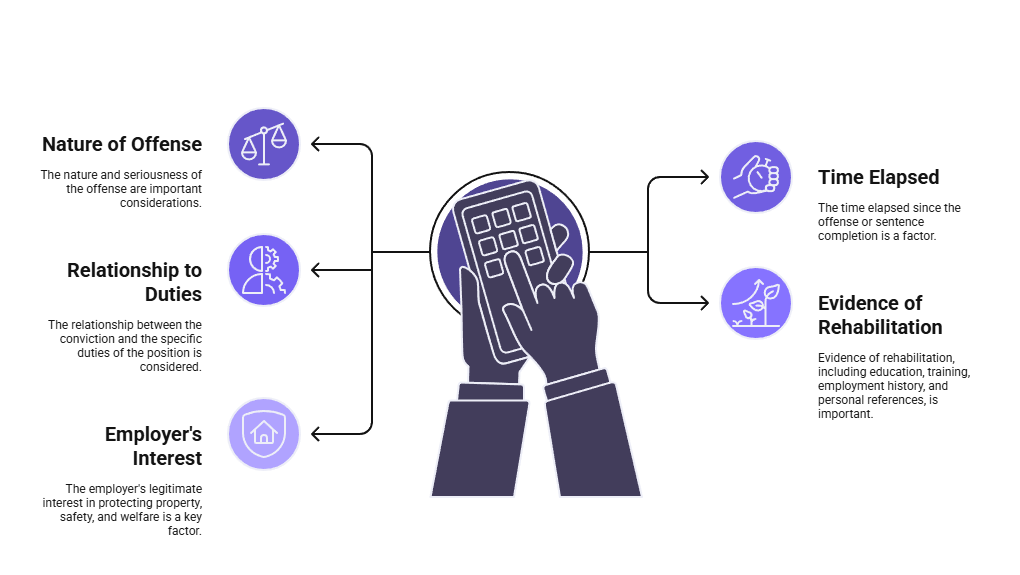
- The nature and seriousness of the offense
- The time elapsed since the offense or sentence completion
- The relationship between the conviction and the specific duties of the position
- Evidence of rehabilitation, including education, training, employment history, and personal references
- The employer’s legitimate interest in protecting property, safety, and welfare
The statute does not mandate a specific format for documenting this analysis, but enforcement agencies and courts expect written records demonstrating meaningful review. Certain positions may be exempt from Article 23-A protections under specific statutory provisions, often involving roles subject to federal or state disqualifications, positions involving vulnerable populations, or law enforcement functions. Employers considering an exemption should verify that the disqualification is expressly required by statute, not based on employer policy, and may benefit from legal review to confirm applicability.
New York illustrates the fact that compliance with the background check is as much about the processes as it is about the law. State standards and city standards encourage employers to take their time and connect the dots between the criminal history and the job responsibilities. When the hiring processes account for the timing, notice, and individualized assessment requirements of the fair chance standards, the fair chance standards become an integral part of the hiring processes and not an exercise in compliance. �
New York City Fair Chance Act: Enhanced Protections
The Fair Chance Act applies to employers with four or more employees operating within New York City limits. It prohibits inquiries into criminal history until after a conditional offer of employment has been made. This “ban the box” provision applies to job applications, interviews, and all pre-offer communications.
Once a conditional offer is extended, employers may conduct a background check. If the results reveal a conviction that the employer believes is relevant to the position, the employer must follow a structured fair chance process before rescinding the offer. This process begins with a written Fair Chance Notice, provided to the applicant using a form that includes specific required elements.
Required Elements of Fair Chance Notice:

- Identification of the conviction(s) at issue
- Explanation of how the conviction relates to the job
- Copy of the background check report
- Statement of the applicant’s rights
- Contact information for the NYC Commission on Human Rights
Timing and Waiting Periods Under the Fair Chance Act
After issuing the Fair Chance Notice, employers must wait a minimum of three business days before taking adverse action. This waiting period allows the applicant to submit a written response, which may include evidence of rehabilitation, factual corrections, or contextual explanations. Employers are required to hold the position open during this waiting period and consider any response provided by the applicant.
If the employer decides to proceed with denial after reviewing the applicant’s submission, a Final Adverse Action Notice must be issued in writing. The Final Adverse Action Notice must state the reason for denial, reference the specific conviction(s), and provide information on how to challenge the decision with the NYC Commission on Human Rights. Employers must retain copies of all notices, background check reports, applicant responses, and internal analyses for at least three years.
Prohibited Records and Per Se Violations
Both New York State and New York City laws restrict the use of certain records.
| Record Type | Permissibility | Notes |
| Arrests without conviction | Prohibited | Cannot be used as basis for adverse action |
| Pending arrests | Generally discouraged | Use may be considered only if the case is active, legally relevant to specific job duties, and subject to individualized assessment; employers should exercise caution and consult legal counsel |
| Sealed or expunged records | Prohibited | Employers accessing these through unofficial channels risk liability |
| Youthful offender adjudications | Prohibited | Treated as non-criminal dispositions under New York law |
Violations involving per se prohibited records often result in strict liability findings, as they reflect procedural failures rather than judgment calls about relevance or rehabilitation.
Operationalizing Compliance for Multi-Jurisdiction Employers
Employers operating in both New York State and New York City must design systems that apply the correct standard to each position. This requires clear definitions of job locations, assignment of jurisdiction tags in applicant tracking systems, and training for hiring managers on procedural triggers.
For positions performed entirely within NYC limits, the Fair Chance Act applies in full. For positions based outside NYC but within New York State, Article 23-A applies without the enhanced procedural requirements. Remote positions complicate this analysis, particularly when employees may work from NYC locations even if the employer’s office is elsewhere.
Best practice involves defaulting to the stricter NYC standard when location ambiguity exists, especially for hybrid or remote roles where the employee has discretion over work location.
Documentation and Recordkeeping Obligations
Employers must maintain written records of the individualized assessment process.
Required Documentation for NYC Positions:
- Copy of the Fair Chance Notice
- Any applicant response received
- Final Adverse Action Notice, if applicable
- Internal memoranda documenting the analysis
- Background check report and related correspondence
For non-NYC positions within New York State, written documentation should demonstrate consideration of the Article 23-A factors, even though the law does not prescribe a specific form. This record serves as evidence of good-faith compliance in the event of a complaint or audit. Retention periods vary by jurisdiction and regulation. NYC’s Fair Chance Act and related guidance support a minimum three-year retention period for background-check-related documentation. Employers subject to federal contracts or other regulatory frameworks should verify whether longer retention applies.
Enforcement Mechanisms and Penalty Structures
The New York State Division of Human Rights enforces Article 23-A violations, while the NYC Commission on Human Rights handles Fair Chance Act complaints. Both agencies have investigatory authority, can issue subpoenas, and may pursue remedies including compensatory damages, civil penalties, and injunctive relief.
| Violation Type | Maximum Penalty | Additional Remedies |
| Willful or repeated Fair Chance Act violations | May reach up to $500,000 in egregious cases | Policy revisions, training, monitoring |
| Individual Fair Chance Act violations | Variable civil penalties | Back pay, front pay, emotional distress awards |
| Article 23-A violations | Compensatory damages | Attorney’s fees, injunctive relief |
While enforcement is primarily administrative, applicants may pursue claims under broader anti-discrimination or human rights statutes in some circumstances. Employers should consult legal counsel to understand potential exposure beyond agency-initiated proceedings.
Coordination with Federal and Other State Laws
New York background check laws 2026 operate alongside the federal Fair Credit Reporting Act, which governs how consumer reports are obtained and used. Employers must comply with FCRA requirements, including providing disclosure, obtaining authorization, and delivering pre-adverse and adverse action notices.
New York’s procedural requirements do not replace FCRA obligations. Employers must integrate both frameworks, ensuring that FCRA notices are issued at the appropriate time and that state-specific fair chance procedures are followed when criminal history is discovered. Employers operating in multiple states should map state-specific requirements and apply the most protective standard when conflicts arise, particularly for positions that may involve interstate work.
Evaluating Alternative Screening Methods
Employers seeking to minimize reliance on criminal background checks may explore alternative screening tools. These include skills assessments, reference checks, educational verification, and employment history confirmation. These methods can provide insight into candidate qualifications without triggering the procedural requirements associated with criminal history inquiries.
Some employers use behavioral assessments, structured interviews, or work sample tests to evaluate candidate suitability. These methods should be designed to measure job-related competencies and applied consistently across all candidates. Technology-assisted screening tools, including algorithmic assessments and data analytics platforms, are subject to separate legal requirements under employment discrimination and privacy laws.
Employers should ensure that any alternative method complies with applicable federal, state, and local regulations and does not introduce discriminatory bias.
Addressing Candidate Disputes and Correcting Errors
Applicants have the right to dispute the accuracy of background check information and to provide context or evidence of rehabilitation. Employers should establish clear procedures for receiving and reviewing applicant submissions, including assigning responsibility to trained personnel and setting internal deadlines.
If an applicant identifies a factual error, such as a misattributed conviction or incorrect disposition, the employer must pause the adverse action process and allow time for correction. Employers should coordinate with the background check provider to resolve discrepancies and obtain updated information. When an applicant provides evidence of rehabilitation, employers must consider that information in the context of the Article 23-A factors and document the updated analysis.
Failure to engage meaningfully with applicant responses can result in findings of procedural noncompliance and may support claims that the employer did not conduct the required individualized assessment.
Training and Policy Development for 2026 Compliance
Effective compliance requires investment in training for hiring managers, recruiters, and HR personnel.
Essential Training Topics:

- Timing of background check inquiries
- Content and delivery of required notices
- Evaluation of Article 23-A factors
- Handling of applicant disputes
- Documentation protocols
Policy documentation should include flowcharts, checklists, and sample forms tailored to the employer’s operational structure. Policies should specify roles and responsibilities, escalation procedures for difficult cases, and recordkeeping protocols. Regular audits of hiring practices, applicant tracking system configurations, and documentation completeness can identify compliance gaps before they result in enforcement actions.
Employers should treat compliance as an ongoing operational function rather than a one-time policy implementation.
Conclusion
Navigating New York background check laws 2026 requires precise understanding of the jurisdictional split between state and city requirements, rigorous documentation, and procedural discipline. Employers who treat compliance as an operational priority, invest in training, and maintain detailed records position themselves to manage risk while making informed hiring decisions.
Frequently Asked Questions
When can I ask about criminal history in New York City?
In New York City, employers may inquire about criminal history only after extending a conditional offer of employment. Asking earlier, including on applications or during interviews, violates the Fair Chance Act. This timing requirement applies to all employers with four or more employees operating within NYC limits.
Does Article 23-A apply to all New York State employers?
Article 23-A applies statewide to all employers unless a specific statutory exemption exists. Exemptions typically involve roles with legally mandated disqualifications or positions involving vulnerable populations. Employers claiming an exemption must demonstrate that the disqualification is required by law, not discretionary.
What happens if an applicant disputes the background check results?
Employers must pause the adverse action process and allow the applicant an opportunity to submit corrections or additional context. The employer is required to review the applicant’s response, update the analysis if necessary, and maintain documentation of the consideration provided before proceeding with any final decision.
Can I use arrest records in hiring decisions in New York?
Arrest records that did not result in a conviction generally cannot be used. Pending arrests may be considered only in rare circumstances where the case is ongoing, legally relevant to specific job duties, and the employer can demonstrate a direct relationship. Even in such cases, reliance on arrest records is legally risky and generally discouraged.
What is the difference between the Fair Chance Notice and the Final Adverse Action Notice?
The Fair Chance Notice is issued after discovering a conviction the employer believes is disqualifying. It must identify the conviction, explain its relevance, and allow the applicant three business days to respond. The Final Adverse Action Notice is issued only if the employer proceeds with denial after considering the applicant’s response.
How long must I keep background check records in New York?
Employers should retain all background-check-related documentation, including notices, applicant responses, and internal analyses, for at least three years. This supports compliance audits, enforcement investigations, and potential dispute resolution.
Do NYC’s Fair Chance Act rules apply to remote workers?
The Fair Chance Act generally applies if the position is based in NYC or the employee will regularly perform work within NYC limits. For remote roles where work location varies or is at the employee’s discretion, employers should consider applying NYC standards as a precautionary measure, as jurisdictional rules continue to evolve.
What penalties apply for violating New York background check laws?
Violations can result in civil penalties that may reach up to $500,000 for willful or repeated offenses under NYC’s Fair Chance Act in egregious cases. Remedies may also include compensatory damages such as back pay, front pay, emotional distress awards, policy revisions, training requirements, and attorney’s fees.
Additional Resources
- New York State Division of Human Rights – Correction Law Article 23-A Guidance
https://dhr.ny.gov/ - NYC Commission on Human Rights – Fair Chance Act Overview
https://www.nyc.gov/site/cchr/law/fair-chance-act.page - Federal Trade Commission – Fair Credit Reporting Act Summary
https://www.ftc.gov/enforcement/statutes/fair-credit-reporting-act - U.S. Equal Employment Opportunity Commission – Background Checks Guidance
https://www.eeoc.gov/laws/guidance/enforcement-guidance-consideration-arrest-and-conviction-records-employment-decisions

ABOUT THE CREATOR
GCheck Editorial Team
Meet the GCheck Editorial Team, your trusted source for insightful and up-to-date information in the world of employment background checks. Committed to delivering the latest trends, best practices, and industry insights, our team is dedicated to keeping you informed.
With a passion for ensuring accuracy, compliance, and efficiency in background screening, we are your go-to experts in the field. Stay tuned for our comprehensive articles, guides, and analysis, designed to empower businesses and individuals with the knowledge they need to make informed decisions.
At GCheck, we're here to guide you through the complexities of background checks, every step of the way.