



DOT physical examinations are federally mandated medical certifications that verify commercial motor vehicle drivers meet minimum health and functional standards established by the Federal Motor Carrier Safety Administration. Employers must integrate these medical evaluations into comprehensive driver qualification processes that include employment verification, motor vehicle record reviews, and drug screening programs to ensure full regulatory compliance.
Key Takeaways
- DOT physicals are required for drivers operating commercial motor vehicles as defined by FMCSA regulations, with certification typically valid for up to 24 months depending on medical conditions.
- Medical examiners must be listed on the National Registry of Certified Medical Examiners to conduct valid DOT physical examinations.
- Employers are responsible for verifying current medical certification status and maintaining documentation as part of the driver qualification file.
- Certain medical conditions require more frequent examinations, additional documentation, or may result in disqualification from operating commercial vehicles.
- Medical certification integrates with other pre-employment screening components including background checks, motor vehicle record reviews, and controlled substances testing.
- Drivers must carry proof of medical certification while operating commercial vehicles, and employers must verify certification before allowing drivers to operate.
- State licensing agencies receive medical certification information through the Federal Motor Carrier Safety Administration’s electronic reporting system.
- Failure to maintain valid medical certification can result in driver disqualification, vehicle out-of-service orders, and significant penalties for both drivers and employers.
Understanding DOT Physical Requirements Within Driver Qualification Standards
The DOT physical examination represents one component of a comprehensive driver qualification framework established under Federal Motor Carrier Safety Regulation Part 391. Transportation employers must view medical certification not as an isolated requirement but as an integrated element within a broader compliance ecosystem. This ecosystem includes employment history verification, driving record analysis, reference checks, and safety performance reviews.
Commercial driver medical standards exist to reduce accident risk by ensuring operators possess the physical, mental, and emotional capacity to safely control large vehicles. These health requirements complement other screening mechanisms that evaluate past behavior, skill competency, and legal eligibility. Together, they form a complete qualification picture for transportation employers.
Who Must Complete DOT Physical Examinations
The requirement for DOT physical examinations applies to drivers who operate commercial motor vehicles in interstate commerce. The definition encompasses several vehicle categories:
- Vehicles with a gross vehicle weight rating of 10,001 pounds or more
- Vehicles designed to transport 16 or more passengers including the driver
- Any size vehicle transporting hazardous materials in quantities requiring placarding
Intrastate commercial drivers may face similar medical examination requirements under state regulations that often mirror federal standards. Employers should verify both federal and state applicability based on the specific routes, vehicle types, and cargo their operations involve.
The Medical Examiner Registry System
Only medical professionals listed on the National Registry of Certified Medical Examiners may conduct examinations that satisfy federal requirements. This registry system, implemented to standardize examination quality, requires healthcare providers to complete specific training on FMCSA medical standards and pass a certification test.
| Eligible Provider Types | Registry Requirements |
| Physicians (MD/DO) | Complete FMCSA training and pass certification test |
| Advanced Practice Nurses | Complete FMCSA training and pass certification test |
| Physician Assistants | Complete FMCSA training and pass certification test |
| Doctors of Chiropractic | Complete FMCSA training and pass certification test |
Examinations conducted by non-registered providers do not satisfy federal requirements regardless of the provider’s general medical qualifications. This registry requirement emphasizes the specialized nature of commercial driver medical evaluation, which differs from standard occupational health assessments. Employers and drivers can verify examiner credentials through the National Registry website before scheduling examinations.
Core Components of the DOT Physical Examination

The medical examination follows standardized protocols outlined in FMCSA regulations and detailed in guidance materials. Understanding these components helps employers anticipate potential issues, prepare drivers for the process, and recognize when additional documentation or specialist evaluations may be necessary.
Medical History Review
Examiners must review comprehensive health history including cardiovascular conditions, respiratory disorders, diabetes, nervous system conditions, mental health history, substance use, and vision or hearing problems. Drivers complete detailed questionnaires covering current medications, past surgeries, hospitalizations, and ongoing treatments.
This history component identifies conditions requiring closer examination, additional testing, or specialist consultation. Incomplete or inaccurate medical histories can result in certification denials or subsequent disqualifications if undisclosed conditions later surface.
Physical Assessment Components
The physical examination includes several standard measurements and evaluations:
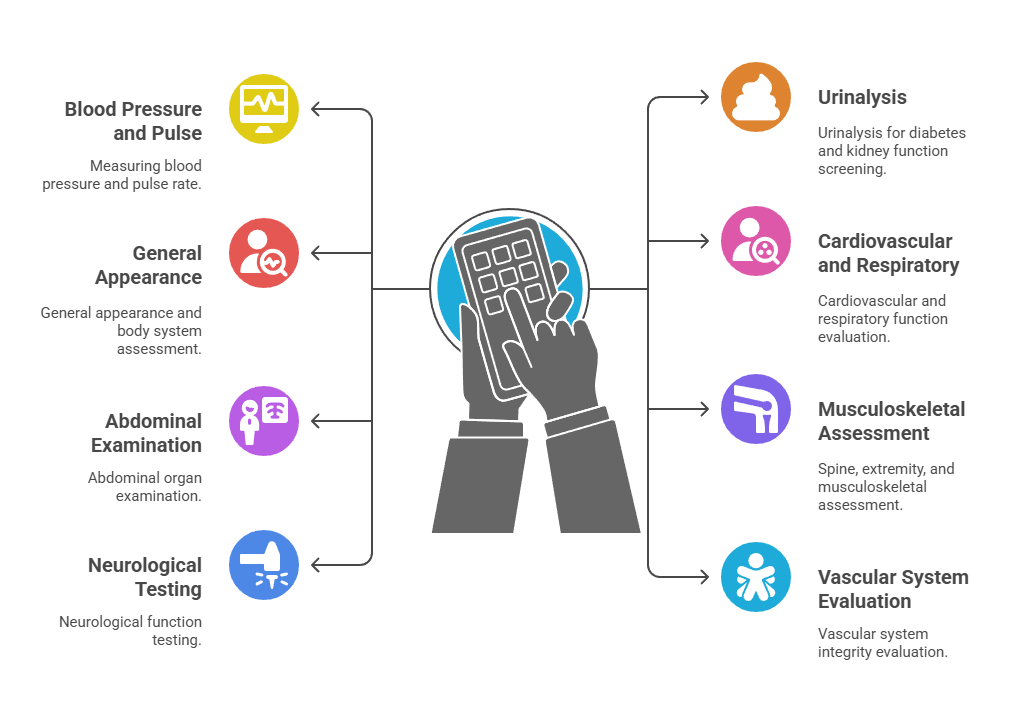
- Blood pressure and pulse rate measurement
- Urinalysis for diabetes and kidney function screening
- General appearance and body system assessment
- Cardiovascular and respiratory function evaluation
- Abdominal organ examination
- Spine, extremity, and musculoskeletal assessment
- Neurological function testing
- Vascular system integrity evaluation
Specific body system evaluations target conditions most likely to impair driving ability or create sudden incapacitation risk. Cardiovascular assessment receives particular attention given the safety implications of conditions that could cause loss of consciousness or physical control.
Vision and Hearing Standards
Under current FMCSA standards, drivers must demonstrate distant visual acuity of at least 20/40 in each eye and both eyes together, and field of vision of at least 70 degrees in horizontal meridian in each eye. Employers should verify current requirements as standards may be updated.
| Standard Type | Minimum Requirement | Alternative Testing |
| Distant Visual Acuity | 20/40 in each eye and both eyes | Corrective lenses permitted |
| Peripheral Vision | 70° horizontal meridian each eye | No alternative |
| Hearing (Whisper Test) | Perceive forced whisper at 5 feet | Audiometric testing alternative |
| Hearing (Audiometric) | Average loss <40 dB at 500, 1000, 2000 Hz | Used when whisper test not met |
These sensory requirements directly relate to hazard perception and response capabilities essential for safe vehicle operation. Employers should ensure drivers understand these standards and obtain necessary corrections before examination.
“Driver safety should begin even before an individual gets behind the wheel.” What catches my eye when it comes to DOT compliance is the fact that it involves more than just getting medical certifications in order. In the transportation industry today, companies are doing a lot more than worrying about how quickly they hire drivers. Instead, they are juggling many different aspects like health standards, compliance, monitoring, and risk management. I believe that the best policies are those that recognize driver qualification as a continuous process. �
Blood Pressure and Cardiovascular Evaluation
Blood pressure standards establish maximum thresholds for certification and determine certification duration. Drivers with stage 1 hypertension may receive certification for one year, while those with higher readings may receive shorter certification periods or require treatment before certification.
Cardiovascular conditions including coronary artery disease, cardiac arrhythmias, and heart valve disorders require individual assessment. Some conditions permit certification with specialist evaluations and documentation, while others may result in disqualification. The examiner evaluates cardiac risk factors including family history, smoking status, cholesterol levels, and diabetes presence.
Medical Conditions and Certification Outcomes
Certain health conditions create automatic disqualifications under federal standards, while others require individual assessment, specialist consultation, or periodic monitoring. Employers benefit from understanding common certification scenarios to set realistic expectations and prepare contingency plans.
Conditions Requiring Additional Documentation
Diabetes management represents a common situation requiring supplemental documentation. Drivers using insulin must obtain determinations through a federal exemption program or demonstrate stable control meeting specific criteria. Those managing diabetes through oral medications or diet modifications typically receive certification with annual renewal requirements.
Sleep apnea has received increased regulatory attention as research has clarified its relationship to drowsy driving risk. Drivers diagnosed with sleep apnea generally must demonstrate treatment compliance through objective monitoring data to maintain certification. Seizure disorders, loss of consciousness conditions, and mental health diagnoses often require specialist evaluations and detailed functional assessments.
Medication Considerations
Certain medication categories create certification concerns due to side effects that may impair driving ability. Medications causing sedation, dizziness, cognitive impairment, or altered consciousness require careful evaluation. Some medications result in temporary disqualification until treatment stabilizes or alternatives are implemented.
Drivers should disclose all medications, including over-the-counter products and supplements, as interactions and cumulative effects can impact certification decisions. Examiners evaluate whether medication regimens permit safe driving or create unacceptable impairment risk.
Certification Duration Variations
FMCSA regulations establish 24 months as the maximum certification duration for drivers meeting all standards without qualification, though medical examiners may issue shorter certification periods based on individual health assessments and conditions requiring monitoring:
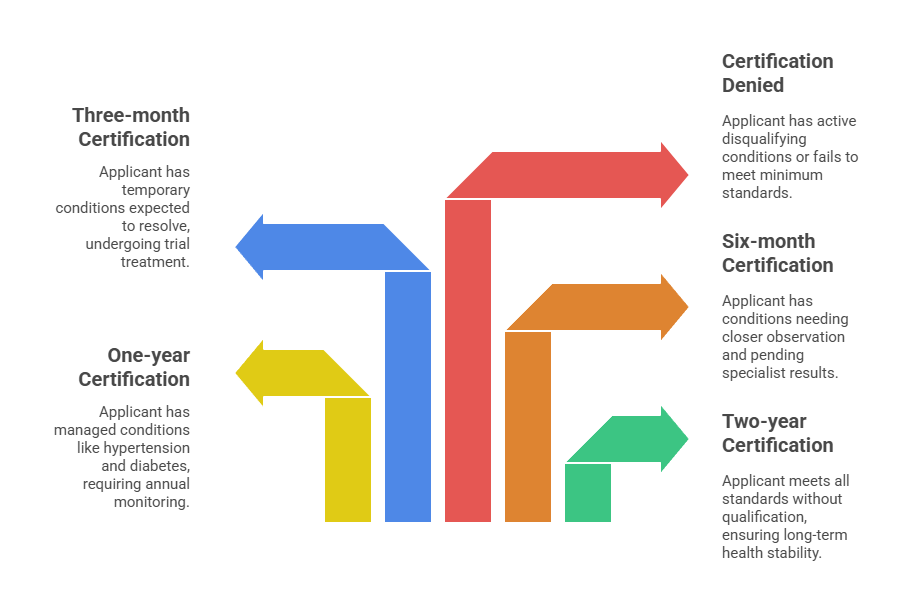
- Two-year certification: No disqualifying conditions, all standards met without qualification
- One-year certification: Controlled hypertension, stable diabetes managed without insulin, other conditions requiring annual monitoring
- Six-month certification: Conditions requiring closer observation, pending specialist evaluation results
- Three-month certification: Temporary conditions expected to resolve, trial treatment periods
- Certification denied: Active disqualifying conditions, failure to meet minimum standards
Employers should track individual certification expiration dates rather than assuming uniform two-year cycles across their driver workforce. Temporary medical conditions may result in certification denials with the opportunity to retest after recovery.
Employer Responsibilities in Medical Certification Management
Transportation employers bear substantial responsibility for ensuring drivers maintain valid medical certification throughout employment. These obligations integrate with broader driver qualification file maintenance requirements and ongoing compliance monitoring duties.
Pre-Employment Verification Integration
Medical certification verification should occur alongside other pre-employment screening activities. Background checks assess past conduct, motor vehicle records reveal driving history, and the DOT physical confirms current medical fitness. These complementary screening components create a comprehensive qualification picture.
Timing coordination matters because medical certifications expire. An examination completed during the application process may expire before the hiring decision concludes if other screening components experience delays. Employers should sequence screening activities to ensure certification validity at the employment start date. Some employers conduct preliminary medical assessments before investing in more expensive screening procedures, while others complete all screening components simultaneously.
Driver Qualification File Documentation
Employers must maintain driver qualification files containing medical examiner’s certificates or documentation of medical variance or exemption. These files represent official records subject to regulatory inspection. Retention requirements specify minimum periods for maintaining documentation.
Required Driver Qualification File Elements:
- Employment application or equivalent
- Motor vehicle record inquiry
- Road test certificate or license equivalency documentation
- Medical examiner’s certificate or medical variance documentation
- Annual driving record inquiry and review
- Annual violation review and certification
- Drug and alcohol testing documentation
Electronic systems for driver qualification file management have become increasingly common. These systems offer automated expiration tracking, renewal reminders, and compliance reporting capabilities. Regardless of format, employers remain responsible for file completeness and accuracy.
Ongoing Certification Monitoring
Medical certification monitoring represents a continuous employer obligation rather than a one-time hiring requirement. Employers must verify that drivers maintain valid certification throughout employment. Immediate removal from driving duties is required for any individual whose certification expires or is rescinded.
Automated tracking systems help manage certification expiration dates across large driver populations, generating alerts as renewal dates approach. These systems should integrate with scheduling functions to prevent assignment of drivers whose certifications will expire before trip completion. Drivers must provide updated medical certificates to employers within a specified timeframe after examination.
Special Certification Programs and Exemptions
Federal programs permit certain drivers who do not meet standard medical requirements to operate commercial vehicles under specific conditions. Understanding these alternative qualification pathways helps employers maximize workforce utilization while maintaining safety and compliance.
Federal Exemption Programs
The FMCSA administers exemption programs for specific medical conditions. These programs establish alternative standards and monitoring requirements for drivers who can demonstrate safe driving ability despite not meeting standard medical criteria.
| Exemption Type | Condition Addressed | Key Requirements |
| Vision Exemption | Monocular vision, other vision deficiencies | Safe driving history, specialist evaluation, annual recertification |
| Diabetes Exemption | Insulin-treated diabetes mellitus | Stable glucose control, endocrinologist evaluation, quarterly monitoring |
| Seizure Exemption | Epilepsy and seizure disorders | Treatment stability, neurologist evaluation, annual recertification |
| Hearing Exemption | Hearing loss exceeding standard thresholds | Safe driving history, specialist evaluation, periodic monitoring |
Exemption applications require substantial documentation including specialist evaluations, driving history records, and sometimes demonstration of safe driving experience in similar vehicles. Approval processes can take several months, and exemptions require periodic renewal with continued documentation of safe performance. Drivers granted federal exemptions must carry exemption documentation along with medical certificates and comply with any special conditions or restrictions.
Skill Performance Evaluation Certificates
The Skill Performance Evaluation program provides an alternative qualification pathway for drivers with certain limb impairments. Qualified examiners assess whether drivers can safely operate commercial vehicles despite physical impairments that would otherwise be disqualifying. This program requires demonstration of safe operation ability through practical assessment rather than meeting standard physical criteria.
Drivers receiving Skill Performance Evaluation Certificates must carry this documentation and are subject to special restrictions appropriate to their specific circumstances. The evaluation considers the specific vehicle type, operational environment, and nature of the physical limitation.
State Intrastate Medical Variations
Some states have established medical certification programs for intrastate commercial drivers that incorporate variations from federal standards. State programs may offer different qualification criteria, examination procedures, or certification durations for drivers operating exclusively within state boundaries.
Employers operating in multiple states should verify applicable medical standards for each jurisdiction. Drivers who operate in interstate commerce must meet federal standards regardless of any more lenient state intrastate requirements.
Integrating Medical Certification With Comprehensive Driver Screening
DOT physical requirements represent one element within a multi-faceted driver qualification and screening framework. Effective compliance programs coordinate medical certification with other verification, assessment, and monitoring activities to create comprehensive safety assurance.
Coordinating Multiple Pre-Employment Requirements
Commercial driver hiring involves numerous regulatory requirements. Each component serves distinct purposes and collectively addresses different risk dimensions:
- Background checks: Reveal criminal history and may uncover disqualifying offenses or patterns of concerning conduct
- Motor vehicle records: Document driving history including violations, suspensions, and accident involvement
- Drug and alcohol testing: Identifies substance use that creates safety risks and regulatory violations
- Medical certification: Confirms physical and mental fitness for driving demands
- Employment verification: Validates work history and identifies gaps or misrepresentations
- Reference checks: Provides performance insights and behavioral patterns from previous employers
Efficient hiring processes coordinate these requirements to minimize delays while ensuring thoroughness. Technology platforms that integrate multiple screening functions can streamline workflow. However, employers must ensure each component meets applicable regulatory standards regardless of integration method.
Ongoing Compliance Monitoring Frameworks
Driver qualification is not a one-time determination but an ongoing status requiring continuous monitoring. Medical certifications expire and must be renewed. Driving records change with new violations or incidents. Background information may reveal new criminal charges or convictions.
Comprehensive compliance programs establish regular monitoring cycles for all qualification elements. Annual motor vehicle record reviews are required by regulation. Medical certification tracking prevents lapses. Periodic background check updates, where legally permissible and operationally practical, may reveal disqualifying developments.
| Monitoring Element | Minimum Frequency | Typical Best Practice |
| Medical certification | Continuous tracking of expiration dates | 60-90 day advance renewal alerts |
| Motor vehicle records | Annual inquiry required by regulation | Quarterly or semi-annual for high-risk positions |
| Violation review | Annual certification required | Immediate review upon incident notification |
| Background checks | No federal requirement for updates | Annual or biennial updates where permitted |
| Drug testing | Random testing per regulatory requirements | Quarterly random selection pools |
Some employers implement quarterly monitoring for high-risk positions or operations subject to particularly stringent oversight. Others adopt risk-based approaches that apply more intensive monitoring to drivers with past compliance issues or performance concerns.
Technology-Assisted Compliance Management
Various technology tools assist with driver qualification tracking, medical certification monitoring, and compliance documentation. Systems range from specialized transportation management platforms to general human resources information systems with transportation-specific modules.
Effective systems provide automated expiration alerts, centralized documentation repositories, audit trail creation, and compliance reporting capabilities. Integration with examination scheduling services, background check providers, and state motor vehicle record systems can further streamline administration. Employers should evaluate these tools based on workforce size, operational complexity, regulatory requirements, and existing system architecture.
Common Compliance Challenges and Risk Mitigation
Medical certification management presents practical challenges that can create compliance gaps if not properly addressed. Understanding common pitfalls and implementing appropriate controls helps employers maintain consistent compliance.
Certification Expiration Gaps
The most common compliance failure involves allowing drivers to operate with expired medical certificates. This situation typically results from inadequate tracking systems, driver failure to schedule timely examinations, examination delays, or administrative oversights in certificate receipt and processing.
Recommended Controls:
- Implement tracking with alerts beginning 60 to 90 days before expiration to allow adequate scheduling time
- Establish backup verification procedures immediately before trip assignments to catch lapses
- Create clear policies establishing driver responsibility for timely renewal
- Define consequences for late certificate submission to reinforce compliance expectations
- Require advance notice when drivers schedule examinations to coordinate administrative processing
Employers should treat expired certification as an immediate disqualification issue requiring removal from driving duties until valid certification is obtained.
Non-Registry Examiner Issues
Examinations conducted by medical professionals not listed on the National Registry do not satisfy federal requirements. This situation can occur when drivers independently schedule examinations without verifying examiner credentials or when previously registered examiners fail to maintain certification.
Employers should maintain lists of verified registry examiners and direct drivers to these providers. Alternatively, establish procedures requiring drivers to confirm and document examiner registry status when using other providers. Periodic verification of certificates against registry records can identify problems requiring corrective action.
Medical Variance Documentation Gaps
Drivers with medical conditions requiring exemptions, Skill Performance Evaluation Certificates, or specialist clearances must maintain current supporting documentation. Missing, expired, or incomplete medical variance documentation creates the same compliance violation as lacking a basic medical certificate.
Tracking systems should flag not only primary certificate expirations but also associated documentation renewal dates. Specialist clearances for cardiovascular conditions, diabetes management reports, sleep apnea treatment compliance data, and similar materials require the same careful monitoring as basic medical certificates.
Interstate Versus Intrastate Confusion
Misunderstanding whether operations constitute interstate or intrastate commerce can lead to application of incorrect medical standards. The interstate commerce definition is broader than many assume. It encompasses activities that are part of cross-state transportation movements even if particular drivers or vehicles never physically cross state lines.
Employers should obtain clear regulatory guidance regarding their operations’ classification and apply appropriately stringent standards. When uncertainty exists, applying federal interstate standards provides greater compliance security than risking misclassification.
Conclusion
DOT physical requirements form an essential component of commercial driver qualification that integrates with background screening, driving record verification, and drug testing. Employers must implement systematic tracking, maintain complete documentation, and coordinate medical certification with other regulatory requirements to ensure continuous compliance while supporting efficient transportation operations.
Frequently Asked Questions
How long is a DOT physical valid for commercial drivers?
Medical certificates are typically valid for up to 24 months when drivers meet all health standards without qualification. However, certain medical conditions require more frequent examinations. Certifications may be valid for 12 months, six months, three months, or other periods based on medical judgment and monitoring needs.
Can employers require DOT physicals before making hiring decisions?
Employers may require medical examinations after making conditional job offers, consistent with Americans with Disabilities Act requirements. The examination should occur after other screening components confirm the candidate is otherwise qualified. Medical standards must be job-related and consistent with business necessity.
What happens if a driver fails the DOT physical examination?
Examination failure results in the medical examiner declining to issue a certificate. Drivers may address disqualifying conditions through treatment or obtain specialist evaluations providing additional documentation. Some may pursue federal exemption programs if eligible. Employers cannot permit drivers without valid certification to operate commercial vehicles.
Do drivers need new DOT physicals when changing employers?
Valid medical certificates remain effective when drivers change employers. The new employer must obtain a copy of the current certificate for the driver qualification file. A new examination is not required unless the existing certificate is near expiration or operational needs dictate more frequent assessment.
Are DOT physicals required for non-driving transportation employees?
Medical examination requirements apply specifically to individuals who operate commercial motor vehicles. Warehouse personnel, dispatchers, mechanics, and other non-driving transportation employees are not subject to DOT physical requirements unless they also perform driving duties requiring commercial driver’s licenses.
How do employers verify medical examiner registry status?
The National Registry of Certified Medical Examiners is publicly searchable on the FMCSA website. Employers can verify examiner credentials by name, registry number, or location before drivers schedule appointments. Verification can also occur after receiving medical certificates by checking the examining provider’s status.
What medical records must drivers provide to examiners?
Drivers should bring documentation of medical conditions, current medication lists, recent test results relevant to chronic conditions, and specialist evaluation reports for significant health issues. Complete disclosure helps examiners make informed certification decisions and may prevent delays from requiring additional documentation after initial examination.
Can drivers with diabetes obtain medical certification?
Drivers with diabetes may obtain certification depending on treatment method and control stability. Those using diet or oral medications typically qualify with annual certification requirements. Insulin-using drivers must meet specific stability criteria or obtain federal exemptions, with additional monitoring and documentation requirements.
Additional Resources
- National Registry of Certified Medical Examiners
https://nationalregistry.fmcsa.dot.gov/NRPublicUI/home.seam - FMCSA Medical Examination Report Form
https://www.fmcsa.dot.gov/regulations/medical/medical-examination-report-mec-form - Federal Motor Carrier Safety Regulations Part 391
https://www.ecfr.gov/current/title-49/subtitle-B/chapter-III/subchapter-B/part-391 - FMCSA Medical Programs Overview
https://www.fmcsa.dot.gov/regulations/medical - Commercial Driver Medical Certification Requirements
https://www.fmcsa.dot.gov/medical

ABOUT THE CREATOR
GCheck Editorial Team
Meet the GCheck Editorial Team, your trusted source for insightful and up-to-date information in the world of employment background checks. Committed to delivering the latest trends, best practices, and industry insights, our team is dedicated to keeping you informed.
With a passion for ensuring accuracy, compliance, and efficiency in background screening, we are your go-to experts in the field. Stay tuned for our comprehensive articles, guides, and analysis, designed to empower businesses and individuals with the knowledge they need to make informed decisions.
At GCheck, we're here to guide you through the complexities of background checks, every step of the way.