



As counterfeit credentials and diploma mills grow more sophisticated in 2026, employers must implement rigorous high school diploma verification protocols that combine traditional contact-based methods with modern digital tools while maintaining strict compliance with FCRA requirements and state-specific privacy laws. This comprehensive guide provides HR professionals with actionable frameworks for authenticating education credentials across diverse hiring scenarios, from manual school outreach to technology-enabled verification systems that address the unique challenges of today’s hybrid workforce.
Key Takeaways
- High school diploma verification is a critical risk management practice that protects employers from negligent hiring liability and ensures workforce competency standards are met.
- The FCRA mandates specific disclosure, authorization, and adverse action procedures when third-party consumer reporting agencies conduct education verifications on behalf of employers.
- Manual verification through direct school contact remains a commonly reliable approach but requires understanding of FERPA restrictions, registrar office protocols, and proper documentation procedures.
- National Student Clearinghouse provides centralized verification for participating institutions but does not cover all high schools, particularly older records or international credentials.
- Diploma mills have evolved to create sophisticated fake credentials complete with fabricated accreditation claims and functional verification phone numbers that require multi-step authentication.
- State and local laws increasingly restrict how employers may use education information in hiring decisions, with some jurisdictions limiting inquiries until specific hiring stages.
- Verification timelines vary significantly based on institution type, record age, and method used, requiring HR teams to build appropriate buffer time into hiring workflows.
- A layered verification approach combining candidate-provided documentation review, direct institutional contact, and database checks offers comprehensive protection against credential fraud.
The Critical Importance of High School Diploma Verification in 2026
The landscape of education credential fraud has fundamentally transformed over the past decade. What once consisted primarily of crude forgeries and easily detected diploma mills now encompasses AI-generated transcripts, deepfake verification calls, and sophisticated websites mimicking legitimate educational institutions. For HR professionals managing hiring processes in 2026, high school diploma verification has evolved from a routine checkbox into a complex due diligence requirement.
Beyond fraud prevention, education verification serves multiple organizational objectives. It validates that candidates meet minimum qualification standards for positions requiring specific educational attainment. It demonstrates reasonable care in hiring practices, which can provide important liability protection if employee performance or conduct issues arise later. Additionally, it ensures compliance with industry-specific regulations that mandate verified education credentials for certain roles.
The shift toward remote and hybrid work arrangements has added new complexity to verification processes. HR teams can no longer rely on in-person document review as a primary authentication method. Simultaneously, the candidate experience has become a competitive differentiator, creating pressure to streamline verification without compromising thoroughness. These competing demands require HR professionals to develop verification frameworks that are both rigorous and efficient.
From my experience as an HR professional, the manner in which a team verifies the educational credentials of an applicant speaks volumes about the culture that is being developed even before the candidate steps into the office for an interview. As such, when an applicant finds that their qualifications and educational credentials are carefully scrutinized, he/she knows that the organization values honesty and transparency from the get-go. The importance of having a rigorous process for verifying the credentials of applicants cannot be overstated. Getting the details right, even the ones that seem routine, is one of the quiet ways HR teams demonstrate real leadership. �
Understanding the Legal Framework Governing Education Verification
Employment-related education verification exists within a complex legal framework that HR professionals must navigate carefully. The Fair Credit Reporting Act establishes foundational requirements when employers use third-party services to conduct verifications. Under FCRA provisions, organizations that regularly assemble or evaluate consumer information for third parties may meet the definition of a consumer reporting agency. Employers using third-party services to conduct verifications should consult legal counsel to understand their specific FCRA obligations, as requirements vary based on the verification approach used.
| FCRA Requirement | Typical Employer Obligation (when using CRA) |
| Pre-screening disclosure | Generally required: Provide standalone document stating a consumer report may be obtained |
| Authorization | Generally required: Obtain written consent from candidate before verification begins |
| Pre-adverse action notice | May be required: Deliver copy of report and summary of rights before making negative decision based on report contents |
| Final adverse action notice | May be required: Send formal notification after reasonable waiting period if adverse decision proceeds |
FCRA requirements depend on whether the verification is conducted by a consumer reporting agency and how the information is used. Employers should consult legal counsel to determine specific obligations.
State and local laws add additional layers of compliance complexity. Some jurisdictions have enacted fair chance hiring laws or educational requirement restrictions that limit when or how education credentials may be considered in hiring decisions. State privacy laws including the California Consumer Privacy Act (CCPA), Virginia Consumer Data Protection Act (VCDPA), and similar statutes in other states impose varying requirements for handling personal information obtained during background checks. HR teams should verify requirements in each location where they hire employees.
FERPA Restrictions on Educational Record Release
The Family Educational Rights and Privacy Act governs how educational institutions handle and release student records. FERPA generally prohibits schools from disclosing education records without student consent, with limited exceptions. Schools may designate certain information such as dates of attendance, degrees earned, and graduation dates as “directory information” that can be released without specific consent under FERPA. However, directory information designations vary by institution, and some schools may require authorization for any record release. Employers should obtain written authorization from candidates to ensure schools can release necessary verification information.
Manual High School Diploma Verification Methods

Direct contact with educational institutions remains a commonly reliable verification approach. This manual method generally provides reliable confirmation when properly conducted and creates a documented audit trail, both critical elements for compliance and risk management. However, effective implementation requires understanding institutional protocols and overcoming common logistical challenges.
Contacting Schools Directly for Verification
The standard manual verification process begins with identifying the correct institution and department. Most high schools handle verification requests through a registrar’s office or administrative department specifically designated for this purpose. Contact information should be independently verified through official channels rather than relying solely on candidate-provided details, as sophisticated fraud schemes sometimes include fake phone numbers that route to accomplices posing as school officials.
When initiating contact, HR professionals should prepare a formal verification request. Essential components include:
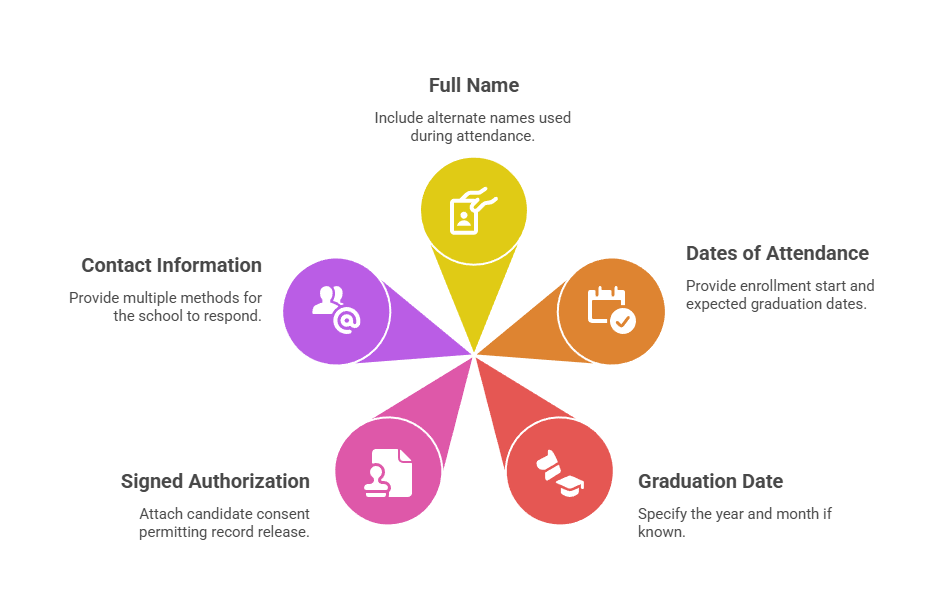
- Candidate’s full name: Include any known alternate names used during attendance.
- Approximate dates of attendance: Provide enrollment start and expected graduation dates.
- Expected graduation date: Specify the year and month if known.
- Signed authorization: Attach candidate consent permitting record release.
- Return contact information: Provide multiple methods for the school to respond.
Response times vary considerably based on institution type and size. Large urban school districts managing thousands of annual verification requests may require three to six weeks for responses, though actual processing times may vary. Smaller rural schools might respond within days but may have limited office hours or seasonal closures during summer months.
Verifying Older Records and Closed Institutions
High school records from decades past present unique verification challenges. Many schools have transitioned record-keeping systems multiple times, potentially creating gaps in digital archives. Some institutions have closed, merged, or reorganized, requiring research to identify current record custodians.
When a high school has closed, records typically transfer to the school district office, state department of education, or designated archive repository. State education agencies maintain directories of closed schools and record custodians. This information is generally accessible through department of education websites or by contacting state record management offices directly.
| Record Age | Typical Custodian | Expected Response Time |
| Less than 10 years | Original school | 1-3 weeks (may vary) |
| 10-25 years | School or district office | 2-4 weeks (may vary) |
| 25-50 years | District or state education agency | 4-8 weeks (may vary) |
| Over 50 years | State archives or education department | 6-12 weeks (may vary) |
For candidates who attended schools in other countries, verification requires understanding international education systems and record-keeping practices. Language barriers and time zone differences add logistical complexity. International credential verification presents unique challenges that may require specialized expertise.
Reviewing Physical Diplomas and Transcripts
While physical document review alone cannot confirm credential authenticity, it serves as an important initial screening step in a comprehensive verification process. HR professionals should understand common security features and indicators that warrant additional scrutiny. Legitimate high school diplomas typically include specific security elements such as embossed seals, specialized paper with watermarks or security threads, raised ink or thermographic printing, and signatures from authorized officials.
Several characteristics may warrant additional investigation:
- Inconsistent formatting: Unusual fonts or generic design elements may indicate fabrication.
- Spelling errors: Mistakes in school names or official titles rarely appear on genuine documents.
- Missing security features: Absence of expected watermarks, seals, or specialized printing raises concerns.
- Pristine condition of old documents: Decades-old diplomas typically show age-appropriate wear.
- Generic language: Vague or non-specific institutional references may suggest fraudulent creation.
Physical document review should always be considered a preliminary step rather than definitive verification. Modern printing technology enables creation of highly convincing forgeries that may deceive even trained reviewers.
Technology-Enabled Verification Solutions
Digital tools have transformed education verification workflows, offering speed and efficiency advantages over purely manual methods. However, HR professionals should understand both the capabilities and limitations of technology-enabled solutions to implement them effectively within compliant verification frameworks. These systems complement rather than replace traditional verification approaches.
National Student Clearinghouse Verification Services
The National Student Clearinghouse operates as a nonprofit organization that provides centralized degree and enrollment verification services for participating educational institutions. Coverage includes many high schools, though participation rates vary significantly by institution type and geographic region. The service maintains records for participating schools and typically provides verification results within 24 to 48 hours for standard requests, though actual processing times may vary based on system load, data complexity, and other factors beyond employer control.
HR teams can access National Student Clearinghouse verifications through participating consumer reporting agencies or directly through institutional subscription agreements. The service verifies dates of attendance, degrees or diplomas earned, graduation dates, and enrollment status when records are available.
However, important limitations affect the utility of the National Student Clearinghouse for comprehensive high school verification programs. Not all high schools participate in the database, with coverage gaps particularly prevalent among smaller schools, private institutions, and schools in certain regions. Older records may not be available even for currently participating institutions if they joined the clearinghouse after a candidate’s graduation.
Digital Verification Platforms and Blockchain Credentials
Emerging technologies are beginning to reshape education credential verification, though adoption remains limited in 2026. Several platforms now offer digital credential verification systems where educational institutions issue blockchain-based diplomas or digital certificates that can be independently verified through cryptographic validation. Blockchain-based systems are designed to create tamper-resistant records through cryptographic validation, though no technology is entirely immune to sophisticated fraud or security vulnerabilities. When properly implemented by legitimate institutions, these systems may offer enhanced verification security compared to traditional paper credentials.
Practical limitations currently restrict widespread adoption:
- Limited institutional participation: Most high schools have not yet implemented blockchain credentialing platforms.
- Standardization challenges: No universal system exists for digital credential issuance and verification.
- Legacy credential gaps: Older credentials issued before digital platform adoption still require traditional verification.
- Technology access barriers: Smaller educational institutions may lack resources for advanced digital systems.
For these reasons, digital credentials currently supplement rather than replace conventional verification approaches.
Identifying Diploma Mills and Fraudulent Credentials
Diploma mill detection has become increasingly challenging as fraudulent operators have grown more sophisticated. Modern diploma mills often feature professional websites, fake accreditation claims, and even staffed phone lines to field verification calls. HR professionals should employ multi-layered validation to identify potentially fraudulent credentials.
Accreditation verification provides a critical first step in diploma mill detection. Legitimate educational institutions in the United States hold accreditation from agencies recognized by the U.S. Department of Education or Council for Higher Education Accreditation. The Department of Education maintains a searchable database of accredited institutions and recognized accrediting agencies.
Several characteristics may suggest potential diploma mill operations and warrant additional scrutiny:
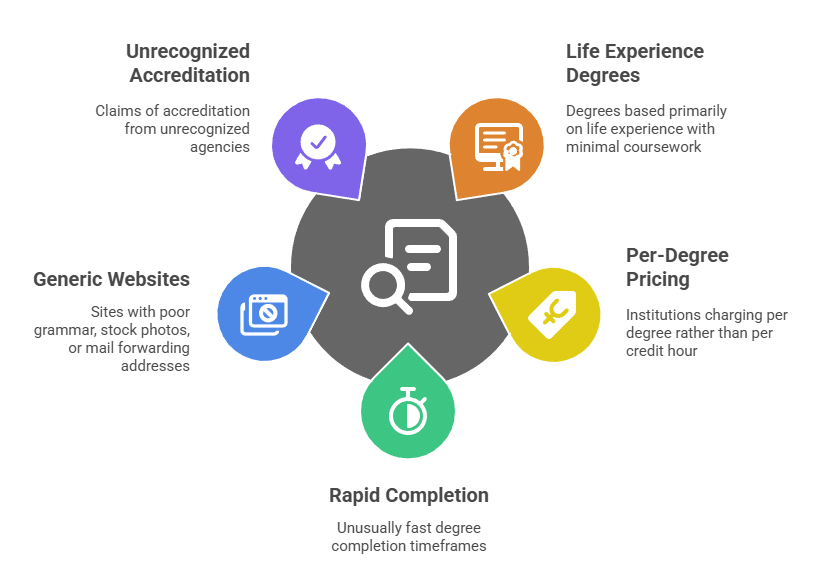
- Life experience degrees: Schools offering degrees based primarily on life experience with minimal coursework may warrant additional investigation.
- Per-degree pricing: Institutions charging per degree rather than per credit hour may warrant additional investigation.
- Rapid completion: Unusually fast degree completion timeframes that would be impossible through legitimate study may warrant additional investigation.
- Generic websites: Sites featuring poor grammar, stock photos, or mail forwarding addresses rather than physical campuses may warrant additional investigation.
- Unrecognized accreditation: Claims of accreditation from agencies not listed in Department of Education databases may warrant additional investigation.
Physical location verification can help assess institution legitimacy. HR professionals can use online mapping tools to verify that claimed campus addresses correspond to actual educational facilities rather than residential addresses or commercial mail receiving locations.
Building a Compliant Verification Process
Effective education verification requires documented procedures that ensure consistency, legal compliance, and appropriate handling of sensitive information. HR teams should develop formal verification protocols addressing each stage of the process from initial authorization through final documentation. These procedures protect both the organization and candidates throughout the verification workflow.
Obtaining Proper Authorization and Disclosure
The verification process begins with proper authorization and disclosure to candidates. When education verification will be conducted by a third-party consumer reporting agency, FCRA generally requires clear disclosure in a standalone document and written authorization before initiating the verification. The disclosure should specifically indicate that a consumer report may be obtained, and the authorization should clearly permit education verification.
Best practice involves using comprehensive background check authorization forms. Key elements include:
- Explicit verification permission: Language specifically listing education verification among permitted checks.
- Institution contact authorization: Permission to contact educational institutions directly.
- Record release authorization: Consent for institutions to release attendance and graduation information.
- Third-party disclosure: Clear statement if consumer reporting agencies will conduct verifications.
- Candidate signature and date: Documented consent with timestamp for compliance records.
State and local laws vary significantly by jurisdiction. HR professionals should work with legal counsel to ensure that authorization forms comply with all applicable state law requirements, which may be more restrictive than federal FCRA standards. Employers should verify requirements in each location where they hire employees.
Handling Verification Results and Making Employment Decisions
When verification results return, HR teams should evaluate the information within appropriate legal and policy frameworks. Results confirming the candidate’s claimed credentials typically allow the hiring process to proceed without additional steps related to education verification. However, discrepancies or inability to verify credentials require careful handling to ensure compliance and fairness.
If verification reveals that claimed credentials cannot be confirmed, HR professionals should first determine whether the issue stems from verification process challenges versus actual credential misrepresentation. Common non-fraud explanations include name changes not communicated to the employer, errors in dates or school names provided by the candidate, records management issues at older or closed institutions, and delays in degree conferral following course completion.
| Verification Outcome | Recommended Action | Typical Timeline |
| Credentials confirmed | Proceed with hiring process | Immediate |
| Unable to verify (process issues) | Request additional candidate information | 3-5 business days |
| Unable to verify (institution unresponsive) | Attempt alternative verification methods | 1-2 weeks (may vary) |
| Discrepancy identified | Consult legal counsel; initiate adverse action if appropriate | Per legal guidance |
| Confirmed misrepresentation | Consult legal counsel before proceeding | Per legal guidance |
When verification establishes potential credential misrepresentation, employers should consult with legal counsel before taking adverse action. If a third-party consumer reporting agency conducted the verification and adverse action may result, FCRA adverse action requirements typically apply.
Documentation and Record Retention Requirements
Proper documentation of verification activities serves multiple purposes including audit trail creation, compliance demonstration, and protection against potential litigation. HR teams should maintain comprehensive records of all verification activities. Required documentation typically includes authorization forms signed by candidates, verification requests submitted to educational institutions or verification services, responses received from schools or verification providers, and documentation of any discrepancies and resolution efforts.
Record retention requirements vary by jurisdiction and organizational policy. FCRA imposes specific requirements for consumer report retention and disposal. Some state laws mandate particular retention periods for background check records. Organizations should work with legal counsel to establish retention policies that comply with all applicable legal requirements while also meeting operational needs for recordkeeping.
Special Verification Scenarios
Certain hiring situations present unique verification challenges requiring adapted approaches. HR professionals should understand how to handle these scenarios while maintaining verification standards and compliance. These situations demand flexibility within established verification frameworks. The early detection of such situations during the recruitment process will ensure that the group is able to plan ahead rather than having to react hastily. The proactive approach in this case not only ensures continuity of process but adds value to the organization.
Remote Hiring and Virtual Document Review
The growth of remote hiring has eliminated the traditional in-person document review process, requiring alternative approaches to initial credential screening. Virtual document review through video conferencing or secure document upload portals can partially supplement physical review, though with important limitations. Remote verification methods should balance convenience with security and thoroughness.
When conducting virtual document review, HR professionals may request that candidates present original documents to a camera in real time. This approach allows review of security features and document conditions. Requests for high-resolution scanned copies or photographs can supplement live review.
However, virtual review provides limited ability to detect sophisticated forgeries and should never be considered definitive verification. Direct institutional confirmation remains essential regardless of document review method. Secure document upload systems should incorporate encryption for data in transit and at rest, access controls limiting who may view submitted documents, audit logging to track document access, and secure deletion capabilities for proper record disposal.
International Education Credential Verification
Candidates educated outside the United States present complex verification challenges due to different education systems, language barriers, and varied record-keeping practices. HR teams should develop specialized protocols for international credential verification. These protocols account for the unique complexities of cross-border education authentication.
Initial steps for international verification include determining the credential equivalency to U.S. education standards. Educational systems worldwide vary significantly in structure, duration, and attainment levels. What constitutes secondary education completion differs across countries.
Direct institutional verification of international credentials follows similar principles as domestic verification but requires additional considerations:
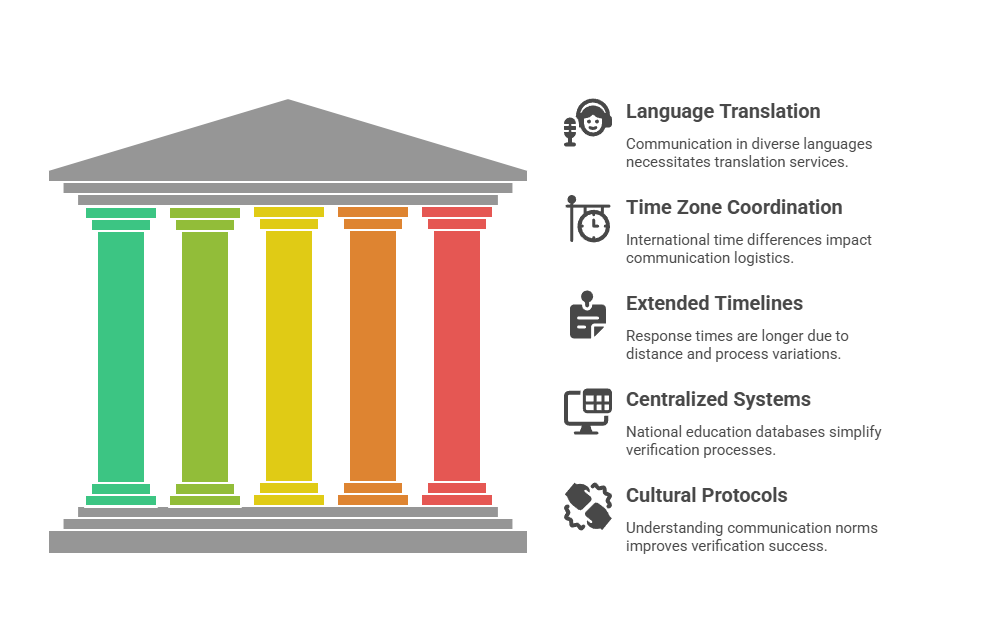
- Language translation: Communication may need to occur in languages other than English, potentially requiring translation services.
- Time zone coordination: International time differences affect communication logistics and response expectations.
- Extended timelines: Response times are often longer than domestic verifications due to distance and process variations.
- Centralized systems: Some countries maintain national education record databases that may simplify verification.
- Cultural protocols: Understanding institutional communication norms in different countries may improve success rates.
International credential verification presents unique challenges that may require specialized expertise. Employers hiring candidates with international education should consider consulting with credential evaluation services accredited by the National Association of Credential Evaluation Services (NACES) or the Association of International Credential Evaluators (AICE), and should work with legal counsel familiar with immigration and international hiring compliance.
Cost Considerations and Efficiency Optimization
Education verification programs involve both direct costs and indirect efficiency impacts on hiring workflows. HR professionals should understand cost drivers and identify opportunities for process optimization. Strategic resource allocation ensures verification thoroughness without unnecessary expense.
Manual verification through direct school contact typically involves processing fees charged by educational institutions, ranging from zero to thirty dollars per verification. Staff time for preparing requests, following up with schools, and documenting results represents a significant cost component. Third-party verification services generally charge between ten and forty dollars per education verification, depending on service level and turnaround time. Database verification through services like National Student Clearinghouse typically costs less than manual institutional contact.
| Verification Method | Approximate Cost Range (2025) | Typical Turnaround | Coverage Limitations |
| Manual school contact | $0-$30 + staff time | 1-6 weeks (may vary) | All institutions (if accessible) |
| National Student Clearinghouse | $5-$20 | 24-48 hours (may vary) | Participating schools only |
| Third-party verification services | $10-$40 | 3-10 business days (may vary) | Variable by service |
| Expedited verification services | $30-$75 | 48-72 hours (may vary) | Premium pricing for speed |
Tiered verification approaches can optimize resource allocation:
- Entry-level positions: Basic diploma confirmation through cost-effective database or standard manual verification.
- Professional roles: Enhanced verification including coursework or degree major confirmation for education-critical positions.
- Regulatory-mandated positions: Comprehensive verification regardless of cost to ensure compliance with industry requirements.
Technology investments can improve long-term verification efficiency. Applicant tracking systems with integrated background check workflows reduce manual data entry and processing time.
Compliance Note: The verification approaches described in this article should be implemented in consultation with legal counsel familiar with the specific federal, state, and local laws applicable to your organization’s hiring locations. Requirements under the FCRA, FERPA, state privacy laws, and fair hiring ordinances vary based on numerous factors including employer size, industry, and geographic operation.
Conclusion
High school diploma verification represents a critical due diligence function that protects employers from fraud risk while ensuring workforce quality standards in an era of increasingly sophisticated credential counterfeiting. By implementing multi-layered verification protocols that combine traditional institutional contact with modern technology-enabled solutions, HR teams can authenticate education credentials efficiently while maintaining strict legal compliance and positive candidate experience.
Frequently Asked Questions
How long does high school diploma verification typically take?
Verification timelines vary based on the method used and the institution involved. National Student Clearinghouse verifications typically return results within 24 to 48 hours when records are available in their database, though actual processing times may vary. Direct contact with high schools generally requires one to six weeks depending on institution size, record age, and current workload. HR teams should build appropriate buffer time into hiring workflows to accommodate verification processing.
Can employers verify education without candidate permission?
Schools may designate certain information as directory information that can be released without specific authorization under FERPA, though designations vary by institution. However, best practice and legal risk management strongly favor obtaining explicit written authorization from candidates before conducting any education verification. When third-party consumer reporting agencies conduct verifications, FCRA generally mandates clear disclosure and written authorization before initiating the process.
What should employers do if a candidate’s diploma cannot be verified?
Inability to verify credentials may result from several factors including school closure, name changes, candidate errors in information provided, or actual misrepresentation. HR professionals should first contact the candidate to request additional information that might resolve verification challenges. If legitimate verification obstacles are identified, alternative verification methods may be acceptable. Employers should consult legal counsel before taking adverse action based on verification results.
Are there different verification requirements for GED certificates versus traditional diplomas?
GED certificates are generally recognized as demonstrating high school equivalency completion, and employers typically treat them as equivalent to traditional diplomas unless specific job requirements necessitate traditional high school attendance. GED certificates are verified through the GED Testing Service or state departments of education rather than individual high schools. Contact information and procedures vary by state.
How can employers identify diploma mills and fake credentials?
Diploma mill identification requires multi-step validation including verification that claimed accreditation comes from agencies recognized by the U.S. Department of Education and confirmation that the institution appears in Department of Education databases. Review the institution’s website and physical location for characteristics that may warrant additional investigation such as credential-selling language, unrealistic completion timeframes, or non-existent facilities. When potentially fraudulent credentials appear in applications, enhanced verification is warranted.
Do education verification requirements differ by state?
While basic verification principles apply consistently across jurisdictions, state and local laws create important variations in how education information may be used in hiring decisions. State and local laws vary significantly by jurisdiction. Some states restrict education requirements that cannot be demonstrated as job-related business necessities. State privacy laws impose varying requirements for handling personal information. Employers should verify requirements in each location where they hire employees.
Can employers verify education credentials from international schools?
International credential verification is possible but often more complex than domestic verification. Approaches include direct contact with foreign educational institutions, use of credential evaluation services that specialize in international education, and verification through centralized education record systems in countries that maintain them. Employers should consider consulting with credential evaluation services accredited by NACES or AICE and should work with legal counsel familiar with international hiring compliance.
What information can schools release during verification without detailed transcripts?
Schools may designate certain information such as dates of attendance, graduation date, degree or diploma type earned, and major or program of study as directory information, though designations vary by institution. More detailed information including specific courses, grades, and full transcripts generally require explicit authorization. Employers should obtain comprehensive education verification authorization from candidates to ensure schools can release necessary information.
Should employers verify education for all positions or only certain roles?
Education verification resource allocation should align with position requirements, risk levels, and organizational policies. Positions where education credentials are legally mandated, critical to job performance, or specifically required by organizational standards typically warrant verification in all cases. Many organizations establish tiered verification policies that match verification intensity to position level.
What recourse do employers have if they hire someone with fake credentials?
Discovery of credential misrepresentation may provide grounds for disciplinary action in some circumstances, though the appropriate response depends on multiple factors including employment agreements, applicable state laws, company policies, timing of discovery, and whether the credential was material to the hiring decision. Employers should consult with legal counsel before taking adverse action based on post-hire verification findings to ensure compliance with all applicable employment laws.
Additional Resources
- Family Educational Rights and Privacy Act (FERPA) Overview
https://www2.ed.gov/policy/gen/guid/fpco/ferpa/index.html - Fair Credit Reporting Act Full Text and Compliance Resources
https://www.ftc.gov/legal-library/browse/statutes/fair-credit-reporting-act - U.S. Department of Education Database of Accredited Postsecondary Institutions and Programs
https://ope.ed.gov/dapip/ - National Student Clearinghouse Degree and Enrollment Verification Services
https://www.studentclearinghouse.org/

ABOUT THE CREATOR
GCheck Editorial Team
Meet the GCheck Editorial Team, your trusted source for insightful and up-to-date information in the world of employment background checks. Committed to delivering the latest trends, best practices, and industry insights, our team is dedicated to keeping you informed.
With a passion for ensuring accuracy, compliance, and efficiency in background screening, we are your go-to experts in the field. Stay tuned for our comprehensive articles, guides, and analysis, designed to empower businesses and individuals with the knowledge they need to make informed decisions.
At GCheck, we're here to guide you through the complexities of background checks, every step of the way.