

INDUSTRY GUIDES

Explore the various Virginia daycare background checks needed, including criminal history verification and child protection screenings.
Created by

Reviewed by

Virginia daycare background checks involve multiple regulatory layers that childcare facility operators must navigate. These include state licensing mandates, Child Protective Services Central Registry verification, and federal database screening. Understanding these requirements ensures workforce compliance with child protection standards while meeting documentation deadlines and approval processes specific to Virginia's childcare industry.
Virginia's childcare regulatory system creates comprehensive oversight of facilities providing care to children. This framework establishes specific background check requirements that exceed general employment screening standards. Understanding this system provides the foundation for compliant hiring practices.
The Virginia Department of Social Services maintains regulatory authority over childcare facilities through the Division of Licensing Programs. This authority covers licensing standards, inspection protocols, and enforcement actions. Facilities operating without appropriate licenses face civil penalties, license suspension, or revocation.
Licensing regulations appear in Virginia Administrative Code Title 22.1. These regulations establish minimum standards for different facility types. They specify background check components, documentation requirements, approval timelines, and circumstances permitting conditional employment. Childcare operators should maintain current copies of applicable regulations and monitor updates affecting compliance obligations.
Within HR, my dealings with childcare centers have made me appreciate the unique nature of background screenings within this field because there are no financial concerns or corporate risks involved; it is all about safeguarding young lives that cannot defend themselves. The multi-tiered approach in Virginia involving state criminal background checks and CPS registry searches is justified, and organizations that take these requirements seriously, as opposed to merely going through the motions, develop the kind of workforce that approaches their jobs with the same degree of passion. From personal observation, those childcare centers that make an effort upfront in ensuring that the background screenings are taken seriously end up creating environments in which parents place trust, employees are proud of their achievements, and children are safe.
Virginia law distinguishes between multiple childcare facility categories, each subject to specific licensing and background check requirements:
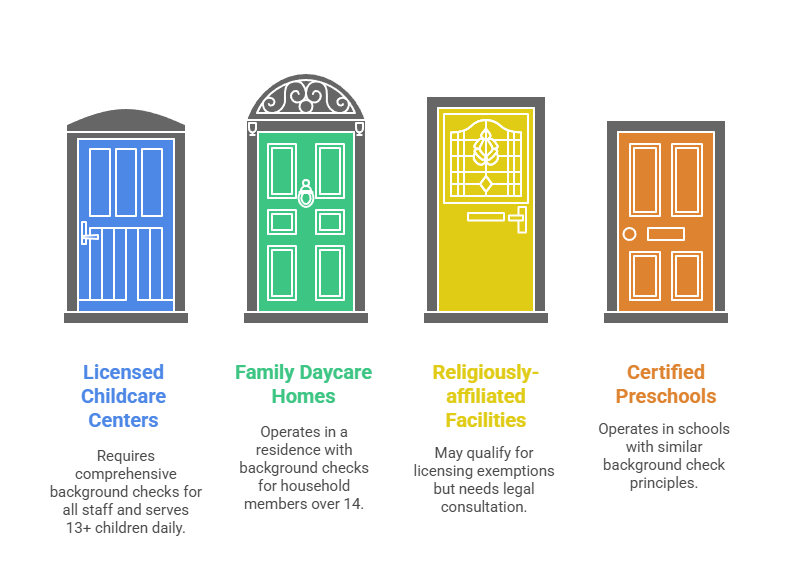
Coordination between school-based programs and educational institution HR departments ensures screening protocols satisfy both childcare licensing and school board employment requirements.
Virginia regulations require background checks for individuals in direct contact with children during care provision. The "direct contact" standard focuses on opportunity for unsupervised interaction with children rather than job title. Kitchen staff, maintenance workers, and administrative personnel working in areas where children are present during operating hours typically require screening.
Contractors and vendors providing services during operating hours create screening considerations. Short-term contractors performing repairs or deliveries under staff supervision may not trigger background check requirements. Ongoing service providers with regular facility access during child presence should undergo appropriate screening to ensure child safety.
Comprehensive background screening for Virginia childcare workers includes multiple verification components addressing different information sources and risk factors. Understanding each component ensures complete compliance while supporting informed hiring decisions.
The Virginia State Police maintains the Central Criminal Records Exchange containing state criminal history information. Virginia law requires CCRE searches for all childcare workers, conducted through fingerprint-based background checks. These provide comprehensive coverage of state arrests, charges, convictions, and pending cases.
| Process Element | Details |
| Submission Method | Electronic through IdentoGO enrollment centers or mobile fingerprinting services |
| Processing Time | 5-7 business days under normal conditions |
| Coverage | Arrests and convictions within Virginia's jurisdiction |
| Disqualifying Crimes | Barrier crimes under Virginia Code § 63.2-1719: murder, manslaughter, sexual offenses, child abuse, kidnapping |
Applicants with criminal history in other states require additional screening components addressing out-of-state records. Organizations should consult legal counsel regarding specific circumstances and barrier crime interpretations.
Federal law under the Child Care Development Block Grant Act requires FBI fingerprint-based national criminal history checks for childcare employees in facilities receiving federal funding. Virginia implements this requirement through integrated fingerprint processing where a single submission triggers both state CCRE and FBI searches simultaneously.
FBI checks reveal criminal history across all U.S. jurisdictions through interstate databases and federal records. Processing timelines generally require 2-4 weeks, longer than state-only CCRE searches due to multi-jurisdictional coordination. Facilities should plan hiring timelines to accommodate FBI processing duration to avoid operational disruptions.
Out-of-state criminal records require evaluation to determine whether offenses meet Virginia disqualifying criteria. Legal counsel can guide this analysis given the complexity of multi-jurisdictional criminal law interpretation. FBI checks capture federal criminal violations including immigration offenses, interstate crimes, and federal court convictions that may not appear in state databases.
Virginia's Child Protective Services Central Registry maintains records of founded complaints of child abuse and neglect investigated by local departments of social services. CPS Registry checks represent unique Virginia requirements separate from criminal background screening, as registry inclusion reflects child welfare findings rather than criminal convictions.
Registry searches occur through request submission to the Virginia Department of Social Services using standardized forms requiring candidate authorization. Processing typically completes within 10-15 business days under normal conditions, though complex cases may require additional time. Founded complaints in the CPS Registry create disqualification from Virginia childcare employment, with registry inclusion reflecting permanent records absent extraordinary legal relief.
Registry checks identify risk factors criminal background checks may miss. Child abuse or neglect founded complaints may result from investigations where criminal charges were never filed. Cases where criminal prosecution resulted in acquittal or situations involving patterns of concern insufficient for criminal conviction but warranting child welfare intervention also appear in the registry.
Virginia law requires verification that childcare workers do not appear on sex offender registries maintained at state or national levels. The Virginia State Police maintains the Sex Offender and Crimes Against Minors Registry, while the U.S. Department of Justice maintains the National Sex Offender Public Website.
Registry searches occur through online database queries using candidate names, aliases, and other identifying information. Organizations should conduct searches through both Virginia and national registries given the mobility of registered offenders across state lines. Sex offender registry presence creates disqualification from childcare employment under Virginia law, with organizations unable to hire individuals appearing on registries regardless of conviction age or offense details.
Common names may produce registry matches requiring additional investigation to confirm whether registry entries actually correspond to employment candidates. Organizations should verify matches through additional identifiers including birthdates, physical descriptions, and address history before making adverse employment decisions based on registry presence.
Virginia regulations establish specific timeframes for background check completion and permit limited provisional employment under strict conditions. Understanding these timelines and conditions enables facilities to balance hiring needs with regulatory compliance and child safety.
Complete background check processing in Virginia typically requires 3-4 weeks from fingerprint submission through receipt of all required verification components:
| Component | Typical Processing Time |
| State CCRE Results | 5-7 business days |
| FBI National Check | 2-4 weeks |
| CPS Registry Search | 10-15 business days |
Organizations should plan for potential delays and maintain communication with candidates during processing. Processing delays occur due to fingerprint quality issues requiring resubmission, name discrepancies between application documents and criminal records, out-of-state record requests requiring additional coordination, and incomplete candidate information slowing verification.
Virginia regulations permit provisional employment of childcare workers under direct line-of-sight supervision while comprehensive background checks complete, as long as specific conditions and documentation requirements are met. This allows facilities to address urgent staffing needs without compromising child safety during screening periods.
Provisional employment requirements include the following conditions:
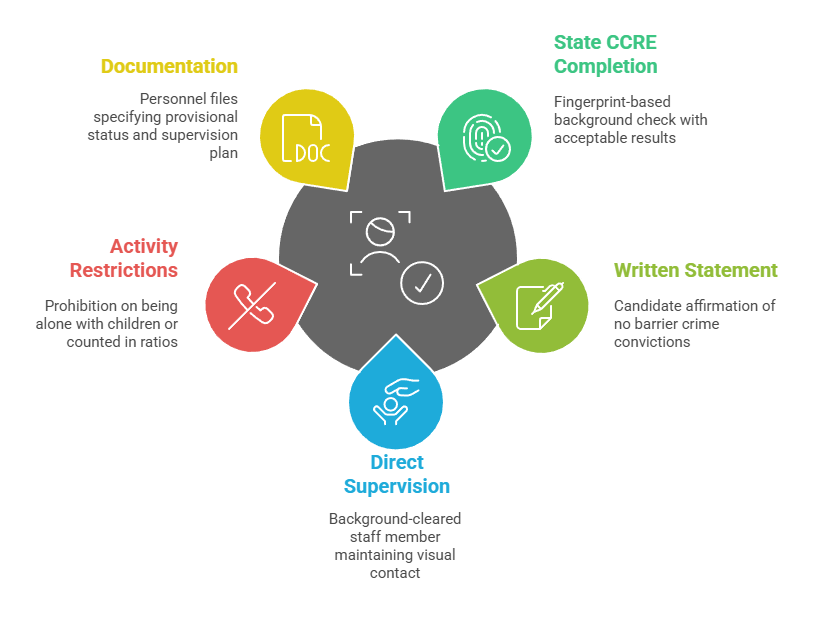
Provisional status ends as soon as any pending background check component returns disqualifying information. Virginia generally allows provisional status for up to 90 days, though organizations should confirm current limits with licensing authorities.
Virginia requires facilities to maintain comprehensive personnel file documentation demonstrating background check compliance. Files must include copies of fingerprint-based background check results, CPS Registry clearance letters, sex offender registry verification documentation, and any correspondence with licensing authorities regarding screening issues.
Documentation should include dates of background check requests, receipt of results, and employment commencement to establish compliance with processing timelines. Licensing inspectors review personnel files during facility inspections. Incomplete documentation, missing required screening components, or evidence of non-compliant provisional employment creates violation findings requiring corrective action.
Record retention requirements extend throughout employment and for at least three years after employment ends under Virginia regulations. Facilities should establish organized filing systems ensuring documentation is readily accessible during inspections and audit reviews.
Virginia requires background check reverification for continuing childcare employees every five years. Establishing tracking systems ensures ongoing compliance throughout employment relationships and protects children from emerging risks.
Reverification should include all components required for initial employment screening: fingerprint-based CCRE and FBI checks, Child Protective Services Central Registry searches, and sex offender registry verification. Facilities should establish tracking systems monitoring reverification due dates, initiating screening with adequate lead time before expiration, and ensuring employment authorization continues during reverification processing.
Reverification discovering disqualifying information requires immediate employment action. Facilities must remove employees from child contact upon learning of barrier crimes, CPS Registry inclusion, or sex offender registration. Organizations should establish protocols addressing interim employment actions, investigation of concerning findings, and termination procedures when disqualifying information emerges.
Some organizations implement more frequent reverification based on risk assessments or facility policies. Positions with extensive child contact or supervisory responsibility may warrant annual or biennial screening to enhance child protection beyond minimum regulatory requirements.
Virginia law establishes specific criminal offenses creating disqualification from childcare employment while providing limited discretion for certain convictions. Understanding disqualification standards enables appropriate candidate evaluation and regulatory compliance.
Virginia Code § 63.2-1719 enumerates barrier crimes generally creating disqualification from childcare employment under Virginia law:
| Category | Specific Offenses |
| Crimes Against Persons | Murder, voluntary manslaughter, felonious assault |
| Sexual Offenses | All sexual crimes involving minors or adults |
| Child-Related Crimes | Child abuse, child neglect, kidnapping, abduction |
| Recent Serious Crimes (5 years) | Drug distribution, assault and battery, fraud, certain property crimes |
Additional offenses may create disqualification based on offense severity and timeframes. Out-of-state convictions receive evaluation based on whether conduct would constitute Virginia barrier crimes if committed in Virginia. Organizations should consult legal counsel to analyze foreign jurisdiction criminal statutes determining offense equivalency.
Deferred adjudications require individual legal analysis to determine whether they constitute disqualifying convictions under Virginia law. Organizations should consult legal counsel when evaluating candidates with deferred adjudication dispositions, providing counsel with complete court documentation for proper assessment.
Not all criminal convictions create automatic disqualification, requiring facilities to evaluate misdemeanor offenses and older felonies through individualized assessment. Virginia regulations permit employment of individuals with certain criminal histories when facilities determine applicants do not pose unacceptable risks to children.
Assessment factors apply only to offenses that are not statutory barrier crimes under Virginia Code § 63.2-1719. Barrier crimes create disqualification regardless of assessment factors. Key considerations include time elapsed since conviction and completion of sentence, offense nature and relationship to childcare responsibilities, number and pattern of criminal offenses, evidence of rehabilitation including employment stability and education, and reference feedback with candidate explanation of circumstances.
Organizations should document assessment rationales establishing reasonable decision-making when employing individuals with non-disqualifying criminal history. Documentation should address specific factors considered, weight assigned to rehabilitation evidence, and conclusions regarding child safety risk to demonstrate due diligence during licensing reviews.
Candidates with pending criminal charges but no convictions create evaluation considerations that require careful policy development. Virginia law does not prohibit employing individuals with pending charges for non-barrier crimes, though facilities may determine such employment poses unacceptable risks pending case resolution.
Organizations should establish policies addressing pending charge situations, including what charge types warrant employment delays, whether employment continues if charges are filed after hiring, and communication protocols with employees about case status updates. Candidates should be required to disclose pending charges and notify employers of any arrests occurring during employment. Failure to disclose or subsequent arrests may constitute grounds for termination regardless of ultimate case dispositions.

Effective background screening programs extend beyond minimum regulatory compliance to implement comprehensive verification supporting child safety, operational integrity, and legal defensibility. Strategic best practices enhance screening effectiveness while facilitating efficient hiring workflows.
Application processes should establish clear disclosure and authorization frameworks to support comprehensive screening. Strong applications require candidates to disclose all criminal history including arrests, charges, and convictions, specify barriers to childcare employment under Virginia law, and obtain written authorization for background check conduct.
Applications should inquire about all prior names used, states of residence, and dates of residence to enable comprehensive records searches. Social Security number verification confirms identity and enables accurate criminal history matching. These elements create a foundation for thorough verification while demonstrating facility commitment to child safety.
Many Virginia childcare facilities utilize third-party background screening services handling fingerprint processing, database searches, and result compilation. Vendor selection should prioritize the following criteria:
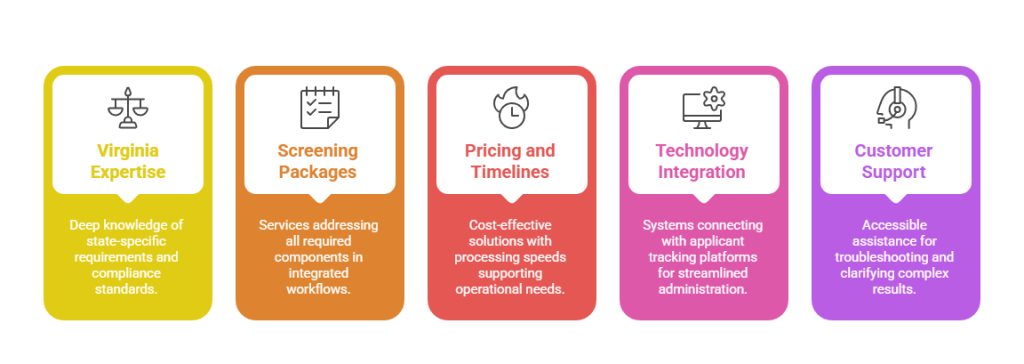
Service level agreements should establish processing timeline expectations, accuracy guarantees, customer support availability, and vendor compliance with data security requirements. Vendors should provide clear result reporting distinguishing between disqualifying findings and information requiring evaluation.
Facility directors, HR administrators, and supervisory staff require training on Virginia background check requirements, disqualifying offense categories, provisional employment conditions, and documentation standards. Training should address regulatory framework basics, common compliance pitfalls, appropriate criminal history evaluation approaches, and confidentiality obligations regarding background information.
Annual training updates should address regulatory changes and emerging compliance challenges. Training documentation proves valuable during licensing inspections by demonstrating organizational commitment to compliance. Facilities should maintain training records including attendance rosters, training materials, and competency assessments.
Periodic internal audits of personnel files verify background check compliance, complete documentation, timely reverification, and proper provisional employment administration:
| Audit Element | Review Focus |
| Documentation Completeness | All required background check components present in personnel files |
| Reverification Tracking | Five-year cycles monitored and screening initiated timely |
| Provisional Employment | Proper documentation of conditions and supervision plans |
| Record Retention | Compliance with three-year post-employment retention requirement |
Audit programs should review representative personnel file samples, identify documentation gaps or compliance deficiencies, implement corrective actions addressing identified issues, and document audit findings and remediation efforts. Common audit findings include missing background check components, expired reverification periods, inadequate provisional employment documentation, and incomplete record retention.
Virginia daycare background checks require comprehensive understanding of multi-layered screening requirements including state criminal history verification, FBI national checks, Child Protective Services Central Registry searches, and sex offender registry confirmation. Childcare facility operators implementing compliant screening programs addressing all regulatory components position their organizations for regulatory compliance, child safety, and operational integrity. Virginia also requires tuberculosis screening for childcare workers; facilities should consult healthcare providers and licensing authorities regarding TB testing protocols to ensure complete workforce health compliance.
Virginia requires fingerprint-based state Central Criminal Records Exchange searches, FBI national criminal history checks for facilities receiving federal funding, Child Protective Services Central Registry verification, and sex offender registry searches at state and national levels. All components must complete satisfactorily before unrestricted employment begins, though provisional employment under direct supervision is permitted with state CCRE clearance.
Complete background check processing typically requires 3-4 weeks from initiation through receipt of all required components. State CCRE fingerprint results typically return within 5-7 business days, FBI checks generally require 2-4 weeks, and CPS Registry searches typically complete within 10-15 business days. Timelines may vary based on case complexity and processing volumes.
Virginia permits limited provisional employment under strict conditions while background checks complete. Requirements include completed state CCRE fingerprint check with acceptable results, written candidate statement, direct line-of-sight supervision by background-cleared staff, prohibition on being alone with children, and documentation of provisional status. Virginia generally limits provisional employment to 90 days.
Virginia Code § 63.2-1719 establishes barrier crimes including murder, voluntary manslaughter, sexual offenses, child abuse or neglect, kidnapping, abduction, and felonious assault. Additional offenses may create disqualification based on conviction recency, including drug distribution, assault and battery, fraud, and certain property crimes within the past five years. Organizations should consult legal counsel regarding specific circumstances.
Yes, the CPS Registry check represents separate screening from criminal background checks. The CPS Registry maintains records of founded complaints of child abuse or neglect investigated by local social services departments. Registry inclusion reflects child welfare findings rather than criminal convictions, and individuals may appear in the registry without criminal charges. CPS Registry presence creates disqualification with no waiver options.
Virginia requires background check reverification for continuing childcare employees every five years. Reverification should include all components required for initial screening: fingerprint-based CCRE and FBI checks, Child Protective Services Central Registry searches, and sex offender registry verification. Facilities should establish tracking systems monitoring reverification due dates and initiating screening with adequate lead time.
Facilities discovering disqualifying information must immediately remove employees from child contact. Barrier crimes, CPS Registry inclusion, or sex offender registration require immediate employment termination as Virginia law prohibits employment of individuals with such findings. Organizations should consult legal counsel regarding termination procedures and document circumstances, actions taken to protect children, and regulatory compliance.
Meet the GCheck Editorial Team, your trusted source for insightful and up-to-date information in the world of employment background checks. Committed to delivering the latest trends, best practices, and industry insights, our team is dedicated to keeping you informed.
With a passion for ensuring accuracy, compliance, and efficiency in background screening, we are your go-to experts in the field. Stay tuned for our comprehensive articles, guides, and analysis, designed to empower businesses and individuals with the knowledge they need to make informed decisions.
At GCheck, we're here to guide you through the complexities of background checks, every step of the way.

Contact us today for efficient, FCRA-compliant screening solutions
designed to keep your hiring process moving safely and smoothly.



LEGAL DISCLAIMER: The information provided in this article is for general informational and educational purposes only and should not be construed as legal advice or a substitute for consultation with qualified legal counsel. While we strive to ensure accuracy, employment screening laws and regulations—including but not limited to the Fair Credit Reporting Act (FCRA), Equal Employment Opportunity Commission (EEOC) guidelines, state and local ban-the-box laws, industry-specific requirements, and other applicable federal, state, and local statutes—are subject to frequent changes, varying interpretations, and jurisdiction-specific applications that may affect their implementation in your organization. Employers and screening decision-makers are solely responsible for ensuring their background check policies, procedures, and practices comply with all applicable laws and regulations relevant to their specific industry, location, and circumstances. We strongly recommend consulting with qualified employment law attorneys and compliance professionals before making hiring, tenant screening, or other decisions based on background check information.