



As of 2026, jobs that most consistently hire people with felony records without a traditional criminal background check tend to fall into three categories: (1) self-employed and freelance roles where the client controls the hiring decision, (2) skilled trades where state licensing rather than employer screening is the main gatekeeper, and (3) gig and hourly roles at smaller local employers with informal hiring cultures. Below, we cover 25 specific roles across these categories, including average U.S. pay, realistic notes on when a check may still apply, and what to expect by employer type and state.
Key Takeaways
- Many jobs for felons with no background check on this list are genuinely accessible, but availability is not absolute. Employer type, state law, and the nature of the role all determine what applies.
- Freelance, self-employed, and gig work typically give you the most control because clients, not corporate HR systems, make the hiring decision.
- Skilled trades like welding, solar installation, and HVAC often hire based on ability and certifications rather than background screens, though licensing boards in some states do consider criminal history.
- Ban-the-Box laws (active across many U.S. states and cities) delay background check questions until later in the hiring process, giving you a fair chance to be evaluated on your qualifications first. Verify your state’s current rules with the National Employment Law Project (nelp.org).
- Fair Chance hiring is growing. The Work Opportunity Tax Credit (WOTC) gives employers a financial incentive to hire people with records. This is most useful to raise after a conditional offer has been made, not in early interviews, where doing so in Ban-the-Box states may require disclosing your record before an employer is permitted to ask.
Introduction
Finding stable, well-paying work after a felony conviction is one of the most difficult challenges in reentry. For justice-impacted individuals, many employers run background checks as a standard step, and a record can disqualify applicants before they ever speak to a hiring manager. For many, background checks create an insurmountable barrier, perpetuating a cycle of rejection and hopelessness.
But the employment landscape is not uniform. Some industries and employers are far more likely to evaluate candidates on skills, certifications, and attitude than on a background report. This guide to high paying jobs for felons with no background check identifies 25 roles where background check requirements are lower or where fair chance hiring creates a genuine opening, while being honest about where checks do still occur.
Throughout this guide, treat background check descriptions as general patterns, not guarantees. Requirements vary by employer, state, and year. Always verify current practices directly with a prospective employer or your state’s labor board.
As Maya Angelou said, “We all have the potential to change. We all have the power to transform. We all have the capacity to give and receive second chances.” Yes, there is a great power in giving second chances. It is still possible to find a high-paying job despite having a criminal record. In today’s constantly changing work environment, there are still opportunities that emphasize skills instead of previous mistakes. It offers individuals the chance to rebuild their lives and contribute meaningfully based on their knowledge, skills, and abilities. As HR professionals, by concentrating on skill development that does not require background checks, we can create opportunities for individuals who have the potential to succeed despite their history. �
Understanding the Employment Landscape for People with Records
The United States has made measurable progress on fair chance hiring over the past decade, expanding access to jobs for felons and other justice-impacted workers. Enforcement and access remain uneven across states and industries, but the direction of change is clear.
What Ban-the-Box Laws Actually Do
Ban-the-Box policies prohibit employers from asking about criminal history on initial job applications, pushing that question to later in the hiring process. This gives applicants the opportunity to be evaluated on qualifications first and to explain their record in context. As of 2026, the majority of U.S. states have some form of Ban-the-Box law, covering both public and, in many jurisdictions, private employers. Coverage varies significantly by city and county as well. Check the National Employment Law Project tracker (nelp.org) for current rules in your state.
What the Work Opportunity Tax Credit (WOTC) Means for You
Employers who hire people with felony convictions within a year of conviction or release may qualify for a federal tax credit of up to $2,400 through the WOTC program. This is most effective to raise after a conditional offer has been made, not in early interviews, where doing so may require disclosing your record before an employer is legally permitted to ask, especially in states with Ban-the-Box protections.
When Background Checks Are Most Common
Regardless of industry, certain conditions make the background check process more likely to apply: jobs involving children or vulnerable adults, roles with access to financial accounts or controlled substances, positions requiring a professional state license, and employment at large corporations with standardized HR processes. The 25 roles below are profiled with these patterns in mind.
Criteria for Including These Jobs
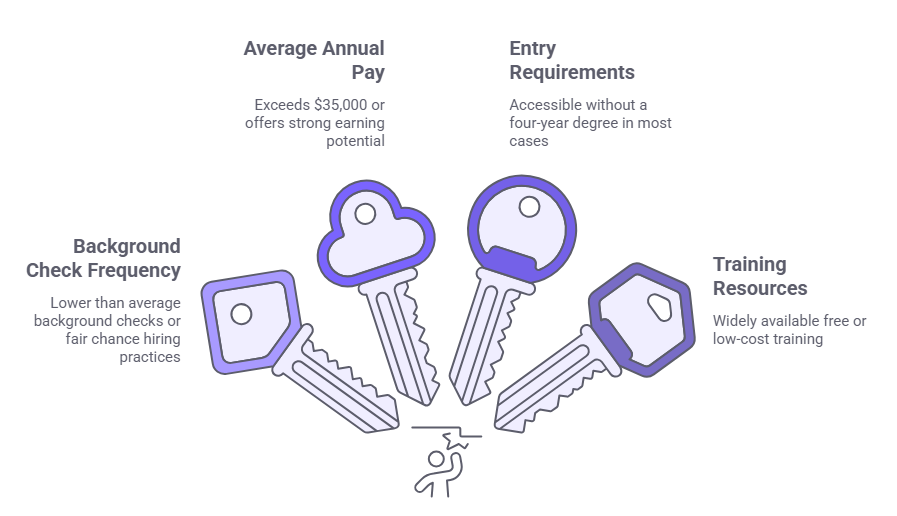
- Background check frequency is lower than average for the role type, or significant fair chance hiring exists in the sector
- Average annual pay exceeds roughly $35,000, or strong earning potential exists through tips, commission, or self-employment
- Entry is accessible without a four-year degree in most cases
- Free or low-cost training resources are widely available
Top 25 High-Paying Jobs for Felons with No Background Check
Each entry covers skills, average pay, why the role tends to work as a no background check job for people with records, an honest note on background check variability, and free training resources to get started.
1. Freelance Writer

- Skills Needed: Strong writing ability, research skills, familiarity with content management platforms, ability to meet deadlines.
- Average Pay: $45,000 to $75,000/year (varies widely by niche and client volume)
- Why It Can Work for You: Freelance writers are hired by clients based on portfolio and pitch quality, not HR background screening systems. You control your own client list and rates. High earners typically specialize in technical, legal, or financial writing.
- Background Check Note: Clients rarely run formal background checks; you operate as an independent contractor. Platforms like Upwork or direct client outreach mean no employer database.
- Free Online Courses: freeCodeCamp (content writing), Coursera: “Good with Words” (University of Michigan), LinkedIn Learning: Freelance Writing Fundamentals
2. Web Developer / Programmer

- Skills Needed: Proficiency in at least one programming language (HTML/CSS/JavaScript is the most accessible starting point), problem-solving, portfolio of completed projects.
- Average Pay: $60,000 to $110,000/year; freelance rates range from $40 to $150/hour
- Why It Can Work for You: Tech hiring is more skills-based than almost any other field. A strong GitHub portfolio often carries more weight than a resume, and many small agencies and startups do not run criminal background checks. Freelancing eliminates employer checks entirely.
- Background Check Note: At large tech companies and firms working on government contracts, checks are standard. Focus on smaller agencies, startups, and freelance work to maximize your options.
- Free Online Courses: freeCodeCamp (full curriculum, free), The Odin Project (free), MIT OpenCourseWare: Introduction to Computer Science
3. Graphic Designer

- Skills Needed: Visual design skills, proficiency in tools like Canva, Adobe Illustrator, or Figma, ability to work with client briefs.
- Average Pay: $40,000 to $70,000/year; strong freelance earning potential
- Why It Can Work for You: Graphic design is largely portfolio-driven. Clients and small agencies hire based on work quality. Freelance platforms and direct client work bypass employer screening entirely.
- Background Check Note: Agency and in-house corporate roles are more likely to involve a formal check. Freelance routes offer the most flexibility for people with records.
- Free Online Courses: Canva Design School (free), Coursera: Graphic Design Specialization (California Institute of the Arts), YouTube: The Futur channel
4. Electrician

- Skills Needed: Understanding of electrical systems, ability to read blueprints, physical stamina, attention to safety codes.
- Average Pay: $55,000 to $85,000/year; journeymen and master electricians earn more
- Why It Can Work for You: Electrical work is in high demand nationwide. Many contractors, especially smaller residential or commercial shops, hire on skill and certifications rather than criminal history.
- Background Check Note: State licensing is a key factor. Most states require a license to work as a journeyman or master electrician, and licensing boards review applications individually, sometimes considering criminal history. Research your specific state board’s policy. Working as an apprentice or for a contractor who sponsors you is a viable path while you build toward licensure.
- Free Online Courses: OSHA Education Center: Electrical Safety (free), Khan Academy: Physics for Electrical Concepts, Mike Holt Enterprises: free electrical study materials
5. Plumber
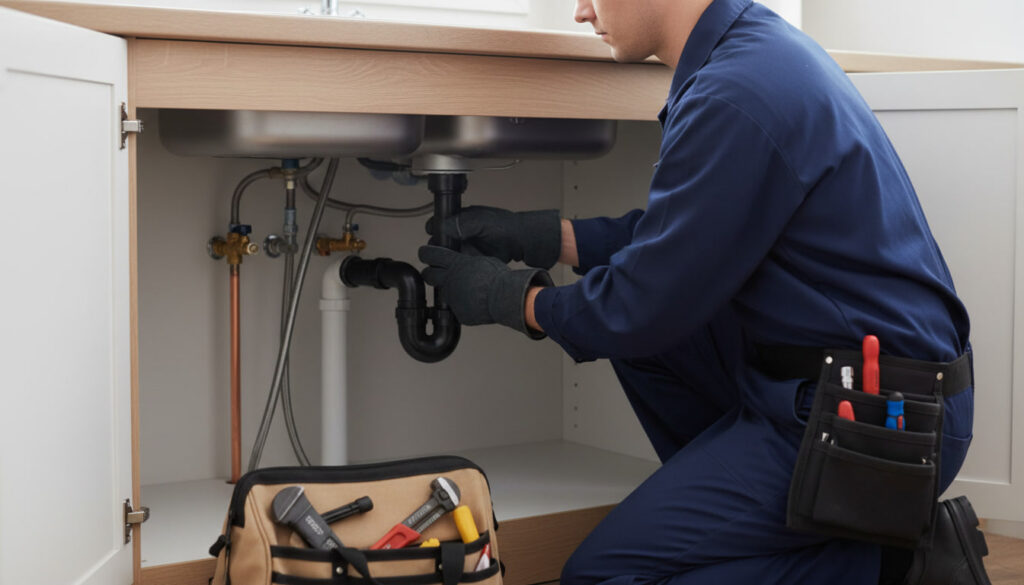
- Skills Needed: Knowledge of piping systems, ability to read blueprints and building codes, physical strength and dexterity.
- Average Pay: $55,000 to $90,000/year
- Why It Can Work for You: Plumbing is a trades field with persistent labor shortages. Small and mid-size plumbing contractors frequently hire on ability and work ethic.
- Background Check Note: Licensed plumbing in most states requires passing a state exam, and the licensing board may review criminal history. The specific offense, how long ago it occurred, and evidence of rehabilitation typically all factor in. Start with an apprenticeship or helper role, but first verify your state’s rules, as some states restrict apprentice or helper work for certain offenses beyond just licensure. Your state’s labor department or a reentry legal aid clinic can advise on current eligibility.
- Free Online Courses: UA (United Association) Apprenticeship information (ua.org), Khan Academy: Physics of Fluid Systems, YouTube: Plumbing 101 channels
6. Commercial Truck Driver (CDL)

- Skills Needed: Valid Commercial Driver’s License (CDL), clean or improvable driving record, physical fitness to meet DOT medical standards, knowledge of cargo and safety regulations.
- Average Pay: $55,000 to $85,000/year; some OTR routes pay $80,000+
- Why It Can Work for You: Many trucking carriers actively recruit people with records and participate in fair chance hiring. The industry faces a persistent driver shortage, and some carriers specifically partner with reentry programs.
- Background Check Note: The CDL process includes a DOT pre-employment background screen and drug test. Most major carriers also run a criminal history check. Importantly, some offenses, including certain drug convictions, carry mandatory FMCSA disqualification periods that may be permanent regardless of carrier policy. Review the FMCSA’s disqualifying offenses list (fmcsa.dot.gov) and consult your state’s DMV before investing in CDL training. For other offense types, smaller regional carriers and owner-operators often have more flexibility.
- Free Online Courses: Your state’s CDL handbook (free at DMV), TruckingTruth.com CDL Study Guide (free), Smith System: defensive driving resources
7. Solar Panel Installer

- Skills Needed: Comfort working at heights, physical fitness, basic electrical knowledge, willingness to earn NABCEP entry-level certification.
- Average Pay: $45,000 to $65,000/year; demand is growing steadily
- Why It Can Work for You: Solar is one of the fastest-growing trades in the U.S. Many installation companies prioritize trained workers and are willing to hire people with records, particularly for residential installs. The work is project-based and skills-focused.
- Background Check Note: Background check frequency varies by employer. Larger solar companies with utility-scale contracts may check; smaller residential installers often do not. NABCEP certification is respected across the industry.
- Free Online Courses: NABCEP Entry Level Certificate preparation materials (nabcep.org), Solar Energy International: free introductory courses, YouTube: Solar Training Network
8. HVAC Technician
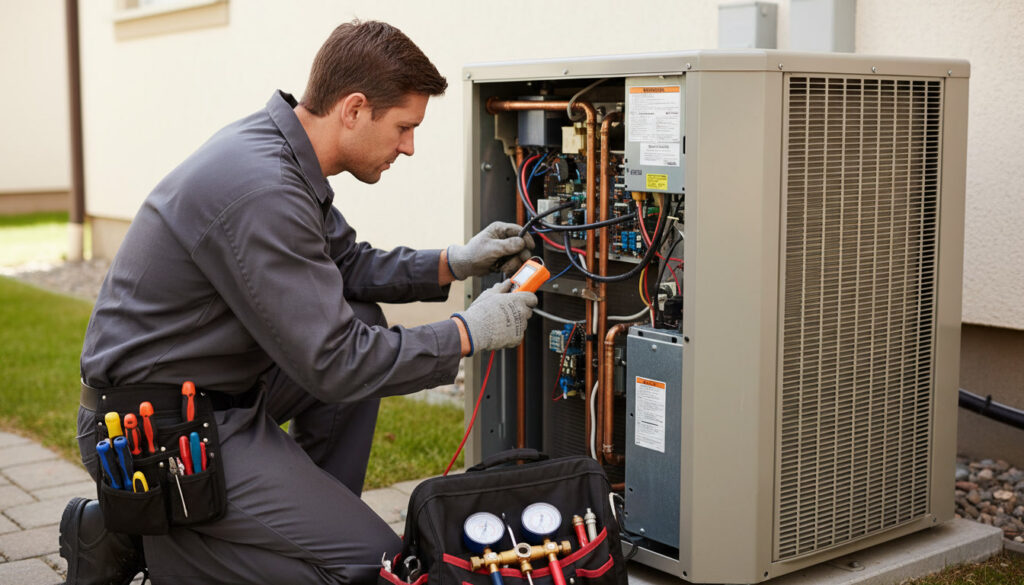
- Skills Needed: Knowledge of heating, ventilation, and air conditioning systems; EPA 608 certification for handling refrigerants; physical dexterity.
- Average Pay: $50,000 to $80,000/year
- Why It Can Work for You: HVAC is a skilled trade with steady demand in both residential and commercial sectors. Many small HVAC contractors hire on technical ability and certifications. EPA 608 certification is the key credential.
- Background Check Note: EPA 608 is a federal certification; the exam itself does not involve a criminal history check. Some state contractor licenses do review criminal history. Check your state’s HVAC licensing requirements. Larger service companies and those with government building contracts are more likely to screen.
- Free Online Courses: ESCO Institute: EPA 608 practice tests (free), Alison: HVAC Technology courses (free), YouTube: AC Service Tech channel
9. Welder

- Skills Needed: Welding technique (MIG, TIG, stick), blueprint reading, knowledge of metals and safety procedures.
- Average Pay: $45,000 to $75,000/year; certified structural welders earn more
- Why It Can Work for You: Welding is heavily skills-based. Many manufacturers and contractors actively look for qualified welders and evaluate candidates primarily on certification and ability. The field has a significant skills shortage.
- Background Check Note: Background check policies vary by employer size and sector. Defense contractors and nuclear facilities check; small job shops and fabrication companies often do not. AWS (American Welding Society) certifications signal competence and expand your options.
- Free Online Courses: Lincoln Electric: free welding courses (lincolnelectric.com), American Welding Society: free online resources, YouTube: welding tutorials by Jody Collier
10. Landscaper / Groundskeeper

- Skills Needed: Physical stamina, knowledge of plants and soil, ability to operate equipment, attention to detail.
- Average Pay: $35,000 to $55,000/year; supervisory and business ownership potential is higher
- Why It Can Work for You: Landscaping has consistent demand and many small to mid-size employers who hire on work ethic and availability. Many small landscaping businesses do not run formal background checks.
- Background Check Note: Background check frequency increases with company size. National landscape management chains and government-contracted groundskeeping positions are more likely to screen. Small local landscaping companies and self-employment are the most accessible starting points.
- Free Online Courses: National Association of Landscape Professionals: online training (landscapeprofessionals.org), YouTube: Lawn Care Academy, Coursera: Horticulture and Landscape (free audit)
11. Construction Worker / Laborer

- Skills Needed: Physical fitness, ability to follow instructions, basic knowledge of construction site safety (OSHA 10 or 30 card helps).
- Average Pay: $38,000 to $60,000/year; skilled tradespeople and foremen earn significantly more
- Why It Can Work for You: General construction labor is one of the most accessible trades for people with records. Many small and mid-size contractors hire based on reliability and willingness to work. Union apprenticeships also offer a structured pathway.
- Background Check Note: Large general contractors on government-funded projects may run checks. Owner-operated construction businesses and subcontractors are generally more flexible. An OSHA 10 card signals safety awareness and improves your standing with any employer.
- Free Online Courses: OSHA Education Center: OSHA 10 Construction (free online), CareerOneStop: construction career pathways (careeronestop.org), YouTube: construction trade basics
12. Heavy Equipment Operator

- Skills Needed: Operation of bulldozers, excavators, cranes, or forklifts; safety awareness; ability to read grade stakes.
- Average Pay: $50,000 to $75,000/year
- Why It Can Work for You: Heavy equipment operators are in demand in construction and extraction industries. Many contractors prioritize machine hours and certifications. OSHA forklift certification and NCCCO credentials open doors.
- Background Check Note: Large unionized projects and government infrastructure contracts often require background checks. Smaller site contractors and rental companies that train operators on-site are generally more flexible.
- Free Online Courses: OSHA Education Center: Forklift Safety (free), NCCCO: certification preparation resources (nccco.org), YouTube: Dirt Perfect channel (equipment operation)
13. Chef / Line Cook

- Skills Needed: Food preparation skills, speed and efficiency under pressure, knowledge of food safety and hygiene, ServSafe certification.
- Average Pay: $35,000 to $60,000/year; executive chefs and specialized cuisine roles earn more
- Why It Can Work for You: The restaurant industry has among the highest fair chance hiring rates of any sector. Kitchens value speed, reliability, and skill above almost everything else. Many culinary employers have explicitly committed to fair chance hiring.
- Background Check Note: Background check frequency is low in most restaurant settings. Positions working directly with children (school cafeterias) or in healthcare foodservice are exceptions. ServSafe certification is the most important credential.
- Free Online Courses: ServSafe: free study materials (servsafe.com), Alison: Culinary Arts courses (free), YouTube: Jacques Pepin Foundation cooking channel
14. Painter (Commercial / Residential)

- Skills Needed: Surface preparation, paint application techniques, knowledge of materials, attention to detail, comfort on ladders and scaffolding.
- Average Pay: $38,000 to $60,000/year; experienced painters and painting contractors earn more
- Why It Can Work for You: Painting is a trade accessible to people with records. Many painting contractors, especially smaller operations, hire on reliability and willingness to learn. Self-employment is also a viable path.
- Background Check Note: Larger painting companies and those with commercial or government contracts may run checks. Small and owner-operated shops are the most accessible.
- Free Online Courses: Painting and Decorating Contractors of America: training information (pdca.org), YouTube: painting technique channels, OSHA Education Center: fall protection
15. Forklift Operator

- Skills Needed: OSHA forklift certification, spatial awareness, ability to operate powered industrial trucks safely.
- Average Pay: $38,000 to $55,000/year
- Why It Can Work for You: Forklift operators are in demand in warehousing, logistics, and manufacturing. Many mid-size distribution centers and manufacturers with high turnover rates are actively hiring and willing to consider applicants with records.
- Background Check Note: Large employers, including Amazon, UPS, FedEx, Walmart, and most publicly traded 3PLs, run background checks as a standard step. Smaller regional warehouses and manufacturing facilities are generally more flexible. Focus on family-owned operations and regional distributors with informal hiring cultures rather than treating headcount alone as the deciding factor.
- Free Online Courses: OSHA Education Center: Powered Industrial Trucks (free), YouTube: forklift safety training videos, Local community colleges: forklift certification (often under $100)
16. Barber

- Skills Needed: Haircutting, shaving, and styling techniques; customer service; knowledge of state cosmetology and barbering code.
- Average Pay: $35,000 to $60,000/year; experienced barbers in busy shops earn more
- Why It Can Work for You: Barbering is a licensed trade in all states, but the licensing process focuses on completing accredited training hours and passing a state board exam, not a criminal history check. Once licensed, barbers are largely self-directed professionals.
- Background Check Note: State licensing boards set the rules for licensure. Most do not have automatic disqualification for felonies, but some boards conduct character reviews for specific offenses. Check your state’s barbering board rules before enrolling in a program.
- Free Online Courses: Your state’s barbering board website (free information), YouTube: barbering technique tutorials, Alison: Salon Management (free)
17. Auto Mechanic

- Skills Needed: Mechanical aptitude, diagnostic skills, familiarity with vehicle systems; ASE certification improves earnings.
- Average Pay: $42,000 to $70,000/year
- Why It Can Work for You: Independent auto repair shops and small dealerships hire primarily on skill and reliability. ASE certification is the key credential that signals competence to any employer.
- Background Check Note: Large dealership groups owned by public companies and national auto service chains (Jiffy Lube, Midas corporate locations) typically run checks. Independent shops and smaller regional dealers are generally more flexible.
- Free Online Courses: ASE study materials (ase.com), Coursera: Automotive Engineering (audit free), YouTube: Scotty Kilmer and EricTheCarGuy channels
18. Mover / Moving Professional

- Skills Needed: Physical fitness, ability to safely handle and transport furniture and heavy items, customer service, clean driving record (CDL may be needed for larger trucks).
- Average Pay: $35,000 to $55,000/year; tips and overtime can add significantly
- Why It Can Work for You: Moving is a physically demanding field that hires based on reliability and strength. Many regional and local moving companies do not run formal background checks and have consistent demand for dependable workers.
- Background Check Note: Interstate moving companies and large national brands (Two Men and a Truck, Mayflower) typically screen. Local and regional operations are generally more flexible. A clean driving record is important for anyone operating vehicles.
- Free Online Courses: YouTube: moving and packing technique videos, OSHA Education Center: back safety and lifting, local community college: CDL prep
19. Roofer

- Skills Needed: Ability to work at heights, knowledge of roofing materials and installation techniques, comfort with physical labor, safety awareness.
- Average Pay: $42,000 to $65,000/year; experienced roofers and crew leads earn more
- Why It Can Work for You: Roofing is a high-demand trade with many small contracting operations. Smaller roofing companies frequently hire on availability and work ethic rather than background reports.
- Background Check Note: Larger roofing contractors working on commercial or government projects may run checks. Residential contractors and smaller crews are generally more accessible.
- Free Online Courses: National Roofing Contractors Association: training resources (nrca.net), OSHA Education Center: Fall Protection (free), YouTube: roofing technique tutorials
20. Tattoo Artist

- Skills Needed: Artistic ability, fine motor skills, knowledge of tattoo equipment and techniques, bloodborne pathogen certification.
- Average Pay: $40,000 to $80,000/year; established artists in busy studios earn significantly more
- Why It Can Work for You: Tattoo studios hire on portfolio quality and technique. The profession does not involve working with vulnerable populations, and the background check culture in most studios is informal. Building a portfolio through apprenticeship is the standard path.
- Background Check Note: Most states regulate tattooing through health department licensing focused on sanitation and bloodborne pathogen safety. These do not typically involve criminal history checks. A few states have added character requirements; verify your specific state’s health board rules.
- Free Online Courses: YouTube: tattooing technique and practice channels, Red Cross: Bloodborne Pathogens training (affordable), Alison: Art and Design fundamentals (free)
21. Truck Dispatcher

- Skills Needed: Organizational skills, communication, knowledge of routing and logistics, familiarity with dispatch software.
- Average Pay: $40,000 to $60,000/year
- Why It Can Work for You: Truck dispatching is a logistics role focused on coordinating drivers and loads. Many mid-size freight brokerages and small trucking companies hire dispatchers based on organizational ability and communication skills.
- Background Check Note: Dispatchers at large publicly traded logistics firms (XPO, J.B. Hunt, Schneider) are typically screened. Smaller freight brokerages and family-owned trucking operations are generally more flexible.
- Free Online Courses: Freight 360: free dispatcher training (youtube.com/Freight360), Alison: Logistics and Supply Chain (free), DAT Solutions: industry resources
22. Home Health Aide

- Skills Needed: Patience, basic caregiving skills, physical stamina, strong communication, CPR/first aid certification.
- Average Pay: $30,000 to $45,000/year
- Why It Can Work for You: Companion and non-medical caregiving work can be accessible to people with records, particularly through private-pay arrangements made directly between a caregiver and a family.
- Background Check Note: This role requires an important distinction. Home health agencies receiving Medicare or Medicaid reimbursement are legally required to conduct criminal background checks, and many states have disqualifying-offense lists that can bar felony-convicted applicants from regulated roles. Private-pay and companion-care arrangements made directly with a family often do not involve a formal check. However, several states maintain caregiver registries or requirements that apply to all paid home-care work regardless of setting. Verify your state’s rules before accepting any paid caregiving role.
- Free Online Courses: American Red Cross: CPR/First Aid, Alison: Healthcare Support Worker (free), CareerOneStop: Home Health Aide pathway (careeronestop.org)
23. Recycling Technician / Waste Handler

- Skills Needed: Physical fitness, comfort with outdoor and industrial environments, ability to operate basic machinery.
- Average Pay: $35,000 to $50,000/year
- Why It Can Work for You: Recycling facilities and waste management operations are labor-intensive environments with consistent hiring needs. Many mid-size operations prioritize reliability over background screening.
- Background Check Note: Municipal waste management jobs (city or county employees) involve government employment and typically require background checks. Private recycling and waste firms vary significantly. Smaller regional operators are generally more flexible.
- Free Online Courses: OSHA Education Center: Waste Handling Safety (free), YouTube: recycling industry training, CareerOneStop: environmental workers pathway
24. Warehouse Associate

- Skills Needed: Physical stamina, attention to detail, ability to follow safety protocols, basic inventory management.
- Average Pay: $35,000 to $50,000/year; supervisory roles pay more
- Why It Can Work for You: Warehouse work is among the most accessible entry-level jobs in the country, and many smaller distribution facilities and manufacturers hire with minimal screening.
- Background Check Note: Background check frequency varies significantly by employer. Amazon, UPS, FedEx, Walmart, Target, and most publicly traded retailers and 3PLs run standard checks. Smaller regional warehouses, local distributors, and manufacturing facilities with informal hiring cultures are generally more flexible. Focus on family-owned operations and regional businesses rather than companies with standardized HR systems. Employer type and hiring culture are more reliable signals than headcount alone.
- Free Online Courses: OSHA Education Center: Warehouse Safety (free), YouTube: forklift and warehouse operations, Local workforce development centers: free logistics training
25. Delivery Driver (Independent / Gig)

- Skills Needed: Valid driver’s license, clean or improvable driving record, reliable vehicle, customer service orientation.
- Average Pay: $35,000 to $55,000/year; varies by market, hours, and platform
- Why It Can Work for You: Gig delivery through platforms like DoorDash, Instacart, and Amazon Flex involves a background check, but screening criteria tend to focus on driving-related offenses and recent violent crimes. Many people with older felony records are approved.
- Background Check Note: All major gig platforms, including DoorDash, Instacart, Uber Eats, and Amazon Flex, run background checks through third-party CRAs under FCRA rules. Screening criteria and lookback windows vary by platform and change periodically; check each platform’s current eligibility policy before applying. If a platform denies your application based on a background report, you have the right under the FCRA to receive a copy of that report and dispute inaccurate information. Independent restaurant delivery work arranged directly with local businesses is less likely to involve formal screening.
- Free Online Courses: Google Maps / navigation proficiency (free), YouTube: gig delivery optimization, CareerOneStop: transportation worker resources
Jobs Where Background Checks Are Likely: Why Fair Chance Hiring Still Gives You Options
Some of the roles people search for when looking for jobs that don’t require background checks are also ones where checks are standard practice. Being clear about this serves you better than being surprised at the application stage.
Roles with near-universal background checks include nursing and direct patient care, teaching, childcare, jobs involving access to controlled substances, financial roles with fiduciary responsibility, and security work. However, “check required” does not always mean “application denied.” Here’s why:
- EEOC guidance strongly recommends that employers conduct an individualized assessment rather than blanket disqualification, considering the nature of the crime, time elapsed, and relevance to the job. While this does not create a private right of action on its own, patterns of blanket disqualification can support a discrimination charge. See eeoc.gov for the full guidance document.
- The Fair Chance Act (2019) prohibits federal agencies and federal contractors from asking about criminal history before a conditional job offer is extended.
- Expungement or record sealing, where available in your state, may limit what employers can legally ask about and consider, but it does not guarantee that old records will no longer appear in commercial database searches, as CRA databases update at varying speeds. Federal records are not expungeable. After any expungement, request your own background report from major CRAs to see what still appears, and consult a reentry attorney before assuming your record is clear.
- WOTC incentivizes hiring. An employer who learns you qualify as a WOTC-eligible candidate has a financial reason to look past a record. Raise this after a conditional offer, not in early interviews.
Resources: EEOC guidance on criminal records and employment (eeoc.gov), WOTC information (irs.gov/wotc), National Inventory of Collateral Consequences (niccc.csgjusticecenter.org)
Tips for Finding Felon-Friendly Jobs
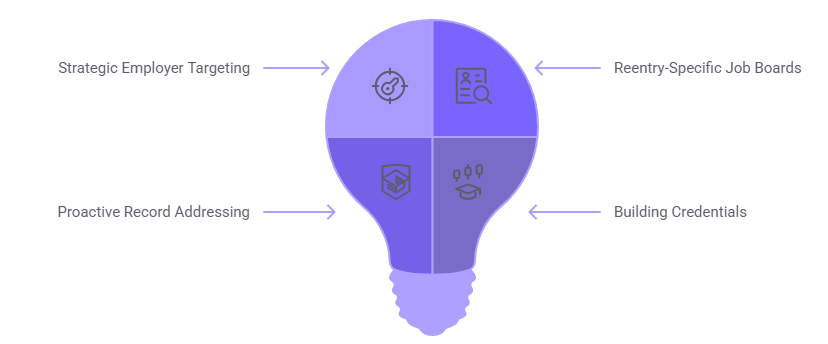
Be Strategic About Which Employers You Target
Employer type and hiring culture matter more than company size. A warehouse associate role at a family-owned distribution company operates very differently from the same title at Amazon. Prioritize family-owned operations, regional businesses, and companies that have publicly stated fair chance hiring commitments. These are more reliable signals than headcount alone.
Use Reentry-Specific Job Boards
Platforms like 70MillionJobs, Honest Jobs, and Jail to Jobs specifically connect people with records to employers who have committed to fair chance hiring. These are your highest-probability starting points and save you from applying blindly.
Address Your Record Proactively
If asked, be honest, brief, and forward-focused: name what happened, state what you have done since, and redirect to what you bring to the role. Many hiring managers respect directness more than evasion. Rehearse this before interviews so it comes across confidently.
Build Credentials That Speak for Themselves
Certifications like OSHA 10, ServSafe, ASE, EPA 608, AWS welding certifications, and CDL are credentials that signal competence before a background check ever comes up. They shift the conversation from your record to your qualifications and give any employer a concrete reason to move forward.
Conclusion
A felony record limits options, and that is worth acknowledging honestly. But it does not eliminate them. The 25 roles in this guide are among the best jobs for felons available today: fields where skills, certifications, and reliability consistently outweigh employment verification and background reports in hiring decisions, particularly at smaller employers and in self-employment contexts.
The most important next steps: research your specific state’s licensing rules for any trade you’re considering, identify employers with explicit fair chance commitments, build credentials that speak before a background check is ever requested, and consult a reentry legal aid organization about whether expungement is available to you.
The employment landscape continues to change as more employers adopt fair chance policies and Ban-the-Box coverage expands. Verify current employer policies directly. This guide provides a practical starting framework, not a guarantee.
Frequently Asked Questions
Can a felon get a job without a background check?
Yes, in many cases. There are jobs for felons where background checks are less common or vary significantly by employer, particularly in freelance and self-employed work, small local businesses, and some gig platforms. The key is targeting employers where skill and reliability drive the hiring decision. Background check practices vary by employer, state, and role, so always verify directly before applying.
What is the highest-paying job for someone with a felony record?
Within the roles listed here, web development and commercial truck driving tend to offer the highest earning potential: $60,000 to $110,000+ for experienced developers and $55,000 to $85,000+ for OTR truckers. Skilled trades (electrician, plumber, HVAC) also have strong earnings once licensing is secured. In practice, the best option depends on your existing skills, your state’s licensing rules, and specific employer fair chance policies.
Do trucking companies hire people with felony convictions?
Some do. The industry has a persistent driver shortage and a number of carriers actively participate in fair chance hiring. The CDL process includes DOT pre-employment screening, a drug test, and a criminal background check, and certain drug convictions carry mandatory FMCSA disqualification periods that may be permanent. Review fmcsa.dot.gov before investing in CDL training, and use reentry-focused job boards to find carriers with stated fair chance policies.
How long does a felony stay on a background check?
Under the FCRA, non-conviction records generally cannot be reported after 7 years for positions paying under $75,000 annually; for higher-paying roles, they may be reportable beyond that window. Convictions can typically be reported indefinitely under federal law, regardless of pay level. State law often provides stronger protections, with some states imposing shorter lookback periods. A reentry attorney or legal aid clinic can advise on what applies in your state.
What is Ban-the-Box and does it apply to my job search?
Ban-the-Box policies remove criminal history questions from initial job applications, requiring employers to evaluate candidates on qualifications first. Policies vary significantly: some apply only to public employers, others extend to private employers. Some cities and counties have ordinances that go further than state law. Verify current coverage in your state and city through the National Employment Law Project (nelp.org).

ABOUT THE CREATOR
GCheck Editorial Team
Meet the GCheck Editorial Team, your trusted source for insightful and up-to-date information in the world of employment background checks. Committed to delivering the latest trends, best practices, and industry insights, our team is dedicated to keeping you informed.
With a passion for ensuring accuracy, compliance, and efficiency in background screening, we are your go-to experts in the field. Stay tuned for our comprehensive articles, guides, and analysis, designed to empower businesses and individuals with the knowledge they need to make informed decisions.
At GCheck, we're here to guide you through the complexities of background checks, every step of the way.