



GCheck delivers background checks in an average of 12 to 24 hours. Motor vehicle records, sex offender registry checks, and sanctions monitoring can return instantly. County and state criminal records set the pace for most orders, since turnaround there depends on how a given court publishes its records. Employment and education verifications run on a separate timeline because they depend on a third party (a former employer or a school registrar) responding.
Key Takeaways
- GCheck delivers background checks in an average of 12 to 24 hours, a pace set mainly by county and state criminal record retrieval.
- Several search types return instantly or in a matter of minutes: motor vehicle records, sex offender registry checks, national criminal database checks, commercial driving credential checks, and business credit reports. OIG and FACIS sanctions monitoring returns near-instantly for the federal OIG layer, though state licensing board data within FACIS updates on that board’s own schedule.
- Federal criminal searches typically return faster than county and state searches, since U.S. District Court records are more centrally maintained.
- Employment verification, education verification, professional license verification, and reference checks run on a different clock, since they depend on a person at a former employer, school, or licensing board responding.
- The single biggest lever on speed is accurate candidate information. A wrong Social Security number or misspelled name is the most common cause of delay across every search type.
Background checks are more than a procedural step added to the hiring process. They are an essential aspect that ensures an organization’s safety, integrity, and success. To both HR professionals and candidates, this added process can be tagged as a waiting game, but it is all worth it as it balances thoroughness with efficiency. In this process, it is important to recognize the factors that influence timelines. Transparency and active communication is the key to managing the expectations of both the organization and the candidates. At the end of it all, we have one goal which is to identify the talent that will best match the qualifications and the culture of the company. �
Average Background Check Turnaround Times
The table below reflects typical GCheck turnaround by search type. “Instant” means results return within minutes of the search running; it does not require a court, registry, or third party to act on the request.
| Search Type | Typical GCheck Turnaround | What Drives the Timeline |
| Motor vehicle records (MVR) | Instant | Direct state DMV database query |
| Sex offender registry | Instant | State and national registry database query |
| National criminal database | Instant | Centralized multi-jurisdiction database query |
| Commercial driving credential checks (CDLIS) | Instant | Federal system query across all issuing states |
| Business credit reports | Instant | Commercial credit bureau query |
| OIG and FACIS sanctions monitoring | Near-instant (federal OIG layer); state licensing board data updates on that board’s schedule | Federal and state exclusion database query |
| Federal criminal search | Faster than county and state searches, often within a few hours | U.S. District Court records are more centrally maintained than county-by-county repositories |
| State and county criminal records | 12 to 24 hours on average | Depends on whether the court’s records are digital or require manual retrieval |
| Employment verification, education verification, professional license verification, reference checks | Varies by third-party response time | Depends on a third party (employer, school, licensing board, prior supervisor) responding |
This is where GCheck’s turnaround claim differs from a single, blanket promise. A background check package that includes only instant searches and a county criminal record can be substantially faster than a package that also includes a professional reference check, because the reference check is waiting on a person, not a database.
Why Some Searches Are Instant and Others Are Not
The fastest searches in a background check query a centralized, digital database and return a result with no human step in between. The slowest depend on a specific court’s recordkeeping, or on a person responding.
Searches That Return With No Human Step
These search types query a database directly. The system asks the database a question and the database answers it, with no clerk, court, or third party involved:
- Motor vehicle records: queried directly from a state DMV database
- Sex offender registry: queried against state and national registries
- National criminal database: scans aggregated records across jurisdictions in one pass
- Commercial driving credential checks (CDLIS): queried through a federal system across all issuing states
- Business credit reports: queried from a commercial credit bureau
- OIG and FACIS sanctions monitoring: federal exclusion data returns near-instantly; state licensing board data within FACIS updates on that board’s own schedule
Why Federal Searches Are Close Behind, and County and State Searches Are Not
Federal criminal searches typically return faster than county and state searches, often within a few hours, because U.S. District Court records are more centrally maintained than the thousands of individual county repositories that state and county searches have to reach into. A search that queries a smaller number of well-organized federal court systems is inherently faster than one that has to reach into a specific county courthouse.
Criminal history at the state and county level is the search type most likely to add real time, and it is where turnaround differs most between providers. Some counties post case dispositions to a searchable digital index the same day they are entered; others still require a clerk to pull a physical file. GCheck’s 12 to 24 hour average reflects a blend of both, weighted toward the jurisdictions where most hiring actually happens, and it is built around the search type that actually drives most orders rather than an average across every search type regardless of how often it is ordered.
What Happens During a Background Check, Step by Step
Understanding the sequence behind a background check explains why some parts finish before a candidate even closes the authorization form, while others are still pending days later.
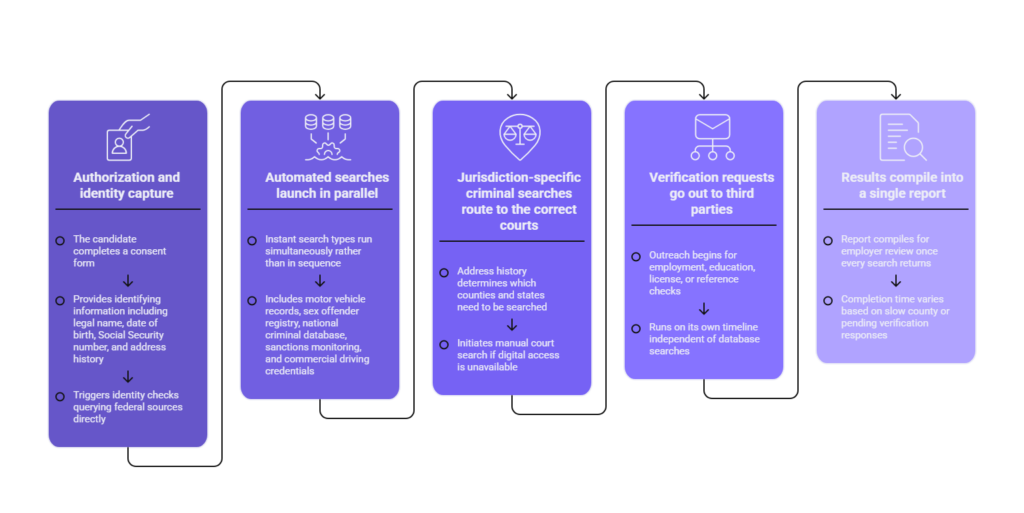
- Authorization and identity capture. The candidate completes a consent form and provides identifying information (legal name, date of birth, Social Security number, and address history). This step also triggers identity checks, which typically return within minutes since they query federal identity sources directly.
- Automated searches launch in parallel. Instant search types (motor vehicle records, sex offender registry, national criminal database, sanctions monitoring, and commercial driving credential checks where applicable) run simultaneously rather than in sequence, since none of them depend on the others’ results.
- Jurisdiction-specific criminal searches route to the correct courts. Address history determines which counties and states need to be searched. This is also the step where a manual court search gets initiated if the relevant jurisdiction does not offer digital record access.
- Verification requests go out to third parties. If the package includes employment verification, education verification, license verification, or reference checks, outreach begins to the relevant employer, school, licensing board, or reference. This step runs on its own timeline, independent of how quickly the database and court searches finish.
- Results compile into a single report. Once every ordered search returns a result (or, for verifications, once the third party responds), the report compiles for employer review. A report with only instant and near-instant searches can be ready within a day; a report that includes a slow county and a pending verification will not be ready until both of those individually slower components clear.
How Long Do Criminal Background Checks Take?
Criminal background checks search court and law enforcement records to identify a candidate’s criminal history. The timeline depends heavily on which level of court holds the relevant record.
Federal Criminal Searches
A federal criminal search queries U.S. District Court records for offenses prosecuted at the federal level, including fraud, embezzlement, and interstate crimes. Because these records are more centrally maintained than the thousands of separate county repositories that state and county searches rely on, federal searches typically return faster, often within a few hours. A federal search is not a substitute for state or county criminal history; it complements those searches by covering offenses that never appear in local court records at all.
State and County Criminal Records
State and county criminal records searches are where turnaround time genuinely varies, and where GCheck’s 12 to 24 hour average is measured. County courts are the authoritative source for most criminal case filings in the United States, and each county maintains its own recordkeeping infrastructure. A metropolitan county with a fully digital case management system can return results in a couple of hours. A rural county that still relies on a clerk retrieving a paper file will add time, sometimes extending a search beyond the 24 hour average. State repositories can help fill gaps where county-level access is limited, but they generally lag slightly behind the county courts where cases are actually filed and resolved.
Sex Offender Registry and Watchlist Checks
Sex offender registry checks and global watchlist and sanctions screening both query structured databases that update on a defined schedule, and both return results instantly once identity is confirmed against a potential match. The only step that can add time is manual review of a possible match, which happens when a name or identifying detail is close enough to a listed record that a person needs to confirm it actually belongs to the candidate rather than someone with a similar name.
Why Employment and Education Verification Take Longer

Verifications work differently from database and court searches.
An employment verification or education and degree verification depends on a response from a person: a former employer’s HR department, a university registrar, or a licensing board. GCheck’s automated outreach reaches these contacts through email and phone as soon as a request is submitted, but the completion timeline ultimately depends on how quickly that third party responds, not on anything GCheck controls directly. A large company with a dedicated verification team might respond within a day; a small business, a school on academic break, or an employer that has since closed can extend that timeline considerably, sometimes by more than a week.
Professional license verification and healthcare credentialing work the same way: they confirm status directly with the issuing state board or institution, and the board’s own processing speed sets the pace. The same is true of professional reference checks, which depend on a former supervisor or colleague actually picking up the phone or responding to an outreach request.
Factors That Influence Background Check Speed

A handful of factors explain most of the variation in how long any individual background check takes, regardless of which searches are included:
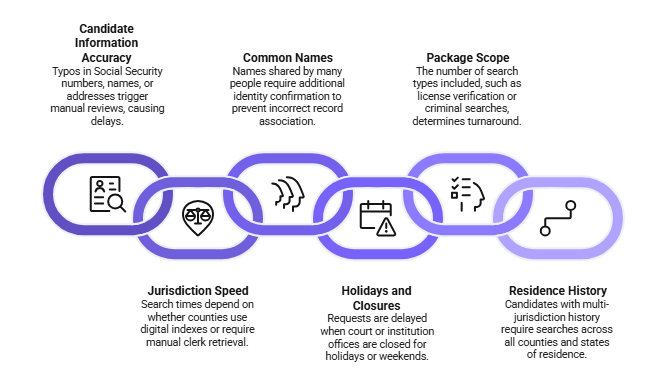
- Accuracy of the candidate’s information. A typo in a Social Security number, a misspelled name, or an incomplete address history is the single most common cause of delay across every search type. Inaccurate identifiers can trigger a manual review step that would not otherwise be necessary, adding days to what would have been an instant result.
- The jurisdiction involved. Some counties post records to a digital index the same day; others require a clerk to retrieve a physical file. A candidate with residence history in several counties, some fast and some slow, will see the search take as long as the slowest jurisdiction in the mix.
- Common names. A name shared by many people in a given database requires additional identity confirmation before a match can be reported. This protects candidates from being wrongly associated with someone else’s record, but it does add a manual review step.
- Court and institution holidays or closures. County courts, state agencies, and university registrar offices all operate on their own business hours. A request that lands the day before a holiday weekend will wait until the office reopens.
- The scope of the package itself. A background check built entirely from instant and near-instant search types will finish faster than one that layers in a county criminal search, a professional license verification, and a reference check. The number of search types included, not the number of results returned, sets the outer bound on total turnaround.
- Multi-jurisdiction residence history. A candidate who has lived in three counties across two states needs all three county searches and both state repositories checked before the criminal history portion of the report is complete. The report is only as fast as the slowest jurisdiction in that set.
International Background Checks
International checks follow a different set of constraints than domestic searches. Instead of querying a centralized U.S. database, an international background check depends on the record access rules, language, and verification infrastructure of each country involved, and those rules vary widely. Some countries maintain digital criminal and education records that a verification partner can query quickly. Others require a police certificate requested in person, or restrict release of criminal records to foreign employers entirely. The realistic timeline for an international check depends on which countries are involved in a specific candidate’s history.
Why Turnaround Time Has Become a Bigger Factor in Choosing a Screening Partner
Turnaround time did not used to be the first question HR teams asked when evaluating a background check provider. Price and coverage carried more weight. That has shifted as hiring timelines compressed and candidates became more willing to accept a competing offer while waiting on a pending check. A screening partner that cannot explain, in specific terms, why one search finishes in minutes and another takes a day leaves HR teams guessing about whether a delay reflects a real problem with the report or simply the mechanics of a particular county court.
This is also where a single average turnaround number, on its own, does not tell an employer very much. Two providers can both advertise a 24 hour average and produce very different candidate experiences if one of them is transparent about which searches are instant, which are faster than average but still not instant, and which depend on a third party responding, while the other reports only the blended number. GCheck’s approach is to publish the breakdown by search type rather than a single figure, so an HR team ordering a package heavy on county criminal records and reference checks can set expectations accordingly rather than assuming every order will land at the average. That breakdown also gives HR teams a clearer basis for comparing providers than a single headline number ever could, since it shows exactly which part of a given package is driving the wait.
How Long Are Background Checks Good For?
A completed background check reflects a candidate’s record as of the date it was run; it is not a permanent record that stays accurate indefinitely. Most employers treat a standard pre-employment check as current for the length of the hiring process itself, generally 30 to 90 days, though this varies by company policy and by industry.
Roles in healthcare, education, and transportation frequently require periodic re-screening rather than relying on the original hire-date check, since license status, exclusion status, and violation history can all change between one check and the next:
| Industry or Role Type | Why a Point-in-Time Check Isn’t Enough | Common GCheck Complement |
| Healthcare | A provider can become excluded from federal programs at any point during employment | OIG and FACIS sanctions monitoring |
| Transportation | License status and violation history can change between annual reviews | Continuous driver qualification file monitoring |
| Regulated licensing (finance, legal, allied health) | A license can lapse, be suspended, or face disciplinary action after hire | Professional license monitoring |
The point-in-time report answers “what does this record show today.” Continuous monitoring answers “has anything changed since,” which is why the two are complements rather than substitutes for each other.
Frequently Asked Questions
What is the fastest type of background check search?
Motor vehicle records, sex offender registry checks, and national criminal database checks all return instantly because they query a centralized digital database with no manual step required, assuming the search does not return a potential match that needs identity confirmation first. OIG and FACIS sanctions monitoring returns near-instantly for the federal layer, though state licensing board data updates on that board’s own schedule.
How long does a criminal background check take?
It depends on the court level. Federal criminal searches typically return faster than county and state searches, often within a few hours, because U.S. District Court records are more centrally maintained. State and county criminal records searches average 12 to 24 hours, though this can extend further in counties that still rely on manual record retrieval.
Why do employment and education verifications take longer than a criminal search?
Verifications depend on a person responding: a former employer’s HR contact, a university registrar, or a licensing board. That response time is outside the screening provider’s direct control, which is why the timeline can range from a day to more than a week depending on how quickly that third party responds.
Can I speed up my background check?
The most effective step is making sure every identifier is accurate before submitting: legal name, Social Security number, dates of employment, and current address. Responding quickly to any request for clarification also prevents a search from stalling in a manual review queue.
Why is my background check taking longer than 24 hours?
The most common reason is a county or state criminal records search in a jurisdiction that requires manual retrieval, or a verification step waiting on a third party to respond. Neither of these delays typically indicates a problem with the candidate’s record; they reflect how that specific court or institution processes requests.

ABOUT THE CREATOR
GCheck Editorial Team
Meet the GCheck Editorial Team, your trusted source for insightful and up-to-date information in the world of employment background checks. Committed to delivering the latest trends, best practices, and industry insights, our team is dedicated to keeping you informed.
With a passion for ensuring accuracy, compliance, and efficiency in background screening, we are your go-to experts in the field. Stay tuned for our comprehensive articles, guides, and analysis, designed to empower businesses and individuals with the knowledge they need to make informed decisions.
At GCheck, we're here to guide you through the complexities of background checks, every step of the way.